

Share this tool:
 |
Description:
Venturefy is an AI-powered relationship mapping and company profile platform built around a specific trust problem: businesses often claim partnerships, customers, integrations, investors, affiliations, and ecosystem connections, but those claims can be hard to verify. Venturefy aims to make business relationships more transparent by combining AI discovery with human verification, then organizing those verified connections into public company profiles and relationship maps.

Venturefy’s strongest idea is that business credibility should be easier to inspect. Most companies already use logos, partner badges, customer mentions, and ecosystem claims in sales material. The problem is that those claims often sit in disconnected places: websites, press releases, app marketplaces, case studies, social posts, partner pages, and pitch decks.
Venturefy tries to turn that scattered evidence into a relationship graph. Its public positioning describes AI-powered relationship mapping, company profiles, and verified partnerships. The claim page says Venturefy blends AI discovery with real human verification to assess the strength and truth of business relationships. That combination matters because AI alone can gather signals, but relationship verification needs evidence and judgment.
The product is most useful when trust is part of the buying decision. A SaaS company may want to show that its integrations are real. A startup may want to prove that its ecosystem connections are more than name-dropping. A buyer may want to check whether a vendor’s claimed partners are legitimate. A business development team may want to find warm paths through existing corporate networks instead of relying only on cold outreach.
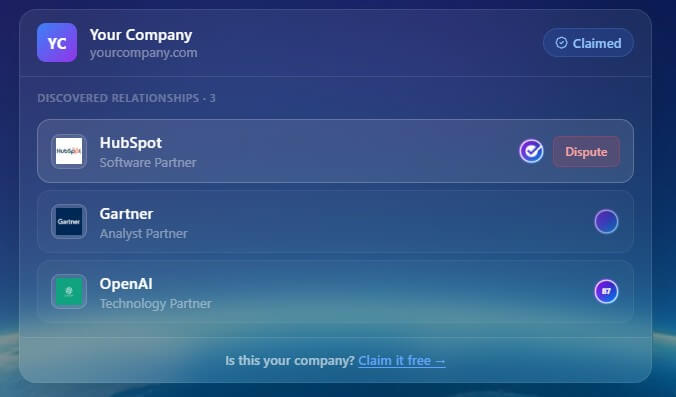
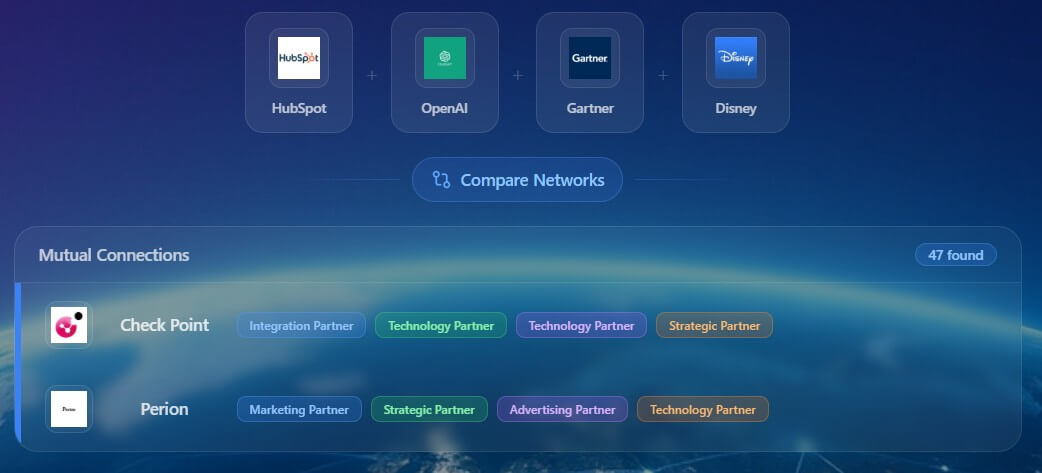
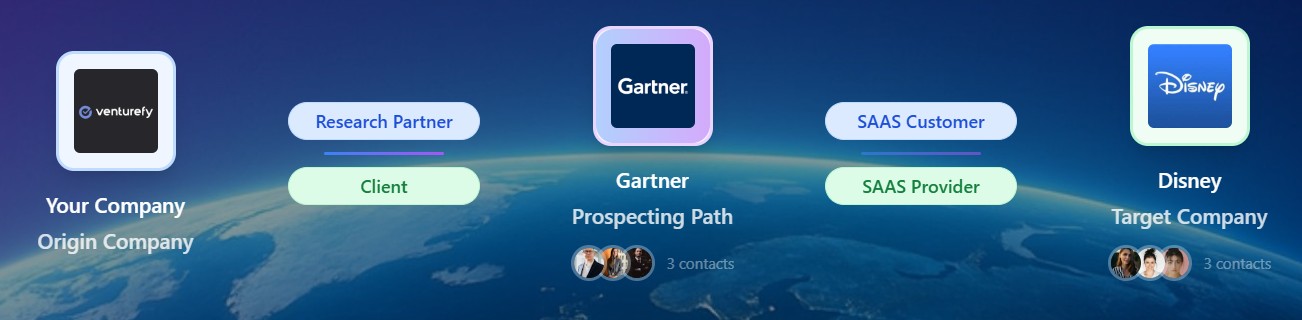
The workflow is built around discovery, verification, and display.
For a company, the first practical step is to claim its profile. That gives the brand a way to review and control how its relationships are shown. This is useful because public relationship data can become messy. A company may have old partners, inactive integrations, outdated customer logos, or connections that were once true but no longer matter.
After that, Venturefy’s value comes from verified relationship listings. The platform’s public language suggests that AI discovers possible connections, while human verification helps judge whether those relationships are real and strong enough to display. This is a better model than a simple scraped database, because business relationships are often nuanced. A paid customer, technology partner, reseller, investor, acquisition, integration partner, and marketing collaborator are not the same kind of relationship.
For buyers and researchers, the workflow is closer to exploration. Search a company, inspect its profile, review relationship listings, and use that information to judge credibility or find ecosystem paths.
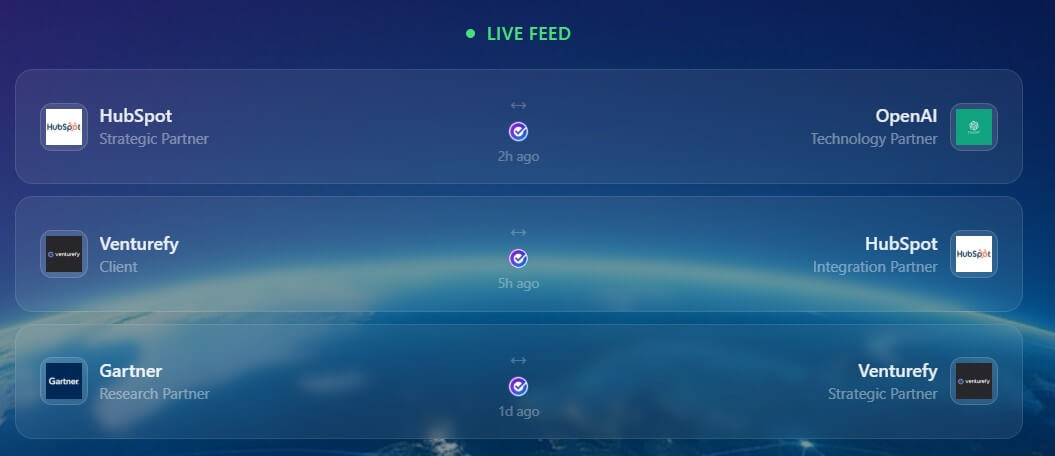
Venturefy should be judged less like a CRM and more like a trust layer for business claims. The key question is not “does it have a lot of data?” It is “can I trust the relationships it shows?”
That is why the human verification angle matters. AI can discover possible links quickly, but relationship evidence can be noisy. A company can mention another company in a blog post without having a meaningful business relationship. A press release can be old. A logo can remain on a website after a partnership has ended. Venturefy’s stated mix of AI discovery and human verification is meant to address that gap.
Still, users should treat Venturefy as a verification aid, not a legal record. It can help surface credible relationship evidence, but sensitive deals, procurement decisions, investor diligence, and partnership claims may still need direct confirmation.
- Brand trust and credibility: Companies can use Venturefy to show verified partnerships, customers, or ecosystem connections in a more structured way than scattered logos on a website.
- Sales enablement: Sales teams can use verified relationship data to support trust-building, especially when buyers want proof that a company is connected to known brands or platforms.
- Business development: Venturefy is useful for finding warm paths through corporate networks, especially when a company wants to understand who is connected to whom before outreach.
- Partner marketing: Companies with active partner programs can use verified relationships to make partner pages, ecosystem pages, and co-marketing claims more credible.
- Investor and analyst research: Investors, analysts, and market researchers can use relationship maps to inspect company ecosystems, customer signals, and partnership strength.
- Vendor evaluation: Buyers can use Venturefy to check whether claimed relationships look supported before trusting sales claims.
Venturefy is not a standard CRM. A CRM tracks your own pipeline, contacts, accounts, and sales activity. Venturefy is more about external trust signals and relationship visibility.
It is also not just a company database. Company data tools often focus on firmographics, employee counts, funding, technologies, and contact information. Venturefy’s angle is relationship verification: which companies are connected, how they are connected, and whether those claims can be trusted.
The closest category is a mix of partner intelligence, trust verification, ecosystem mapping, and corporate relationship discovery. That is a narrow but useful lane, especially as AI-generated claims and low-trust online content make business credibility harder to judge.
- Venturefy’s main limitation is coverage. Relationship mapping becomes more useful as the graph grows. If a company or industry has limited verified data, the profile may not tell the full story.
- The second limitation is relationship nuance. Even verified relationships need context. A company may have a partnership that is technically real but commercially minor. Another may have a customer relationship that is confidential and therefore not visible. Users should avoid reading every visible or missing connection as a complete truth.
- There is also a workflow adoption challenge. For Venturefy to become more valuable, companies need to claim profiles, verify relationships, and keep details current. Without active participation, some profiles may lag behind reality.
- Start by claiming the company profile and reviewing existing relationship listings. Remove outdated claims, strengthen important ones, and prioritize relationships that buyers care about.
- Use Venturefy as support for credibility, not as the only proof. Strong relationship pages should still connect to case studies, integration pages, partner directories, or direct confirmation where appropriate.
- For sales teams, look for relationship paths before outreach. A verified ecosystem connection can make a message warmer and more specific.
- For buyers, review the type of relationship, not just the company name. A verified integration, customer, reseller, and investor connection each means something different.
Venturefy is best for companies that want to make business relationships more transparent, credible, and useful.
Its strongest value is the combination of AI-powered relationship discovery, public company profiles, and human-verified partnership signals.
The main caveat is that relationship data still needs context. Venturefy can make trust easier to inspect, but important business decisions should still be backed by direct evidence and human judgment.
TAGS: Marketing
Related Tools:

Assists creators with social media data analysis

Create highly detailed 3D models and textures

Generates creative campaign ideas

Helps businesses track, analyze, and improve their visibility

Automates the creation of ad campaigns for effective marketing

Easily create custom logos and brand identities