Share this tool:
 |
Description:
Sumly.ai is an AI podcast-summary service for people who want the value of long-form podcasts without spending hours listening to every episode. Its main promise is not just “summarize this show.” The stronger idea is that Sumly builds a user profile, monitors selected podcasts, and sends tailored insights, notes, strategies, and takeaways automatically when new episodes are released.
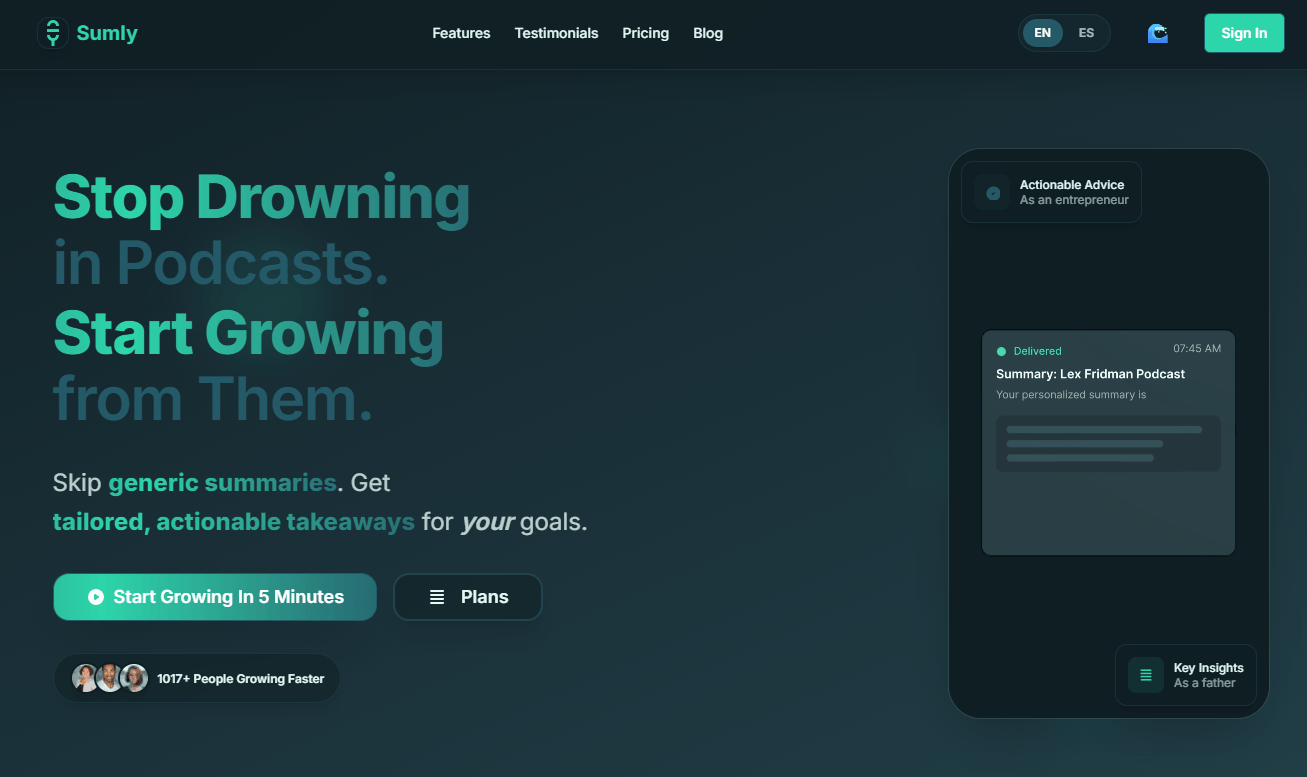
Sumly adapts summaries to the user’s profile, interests, goals, and context instead of sending the same summary to everyone.
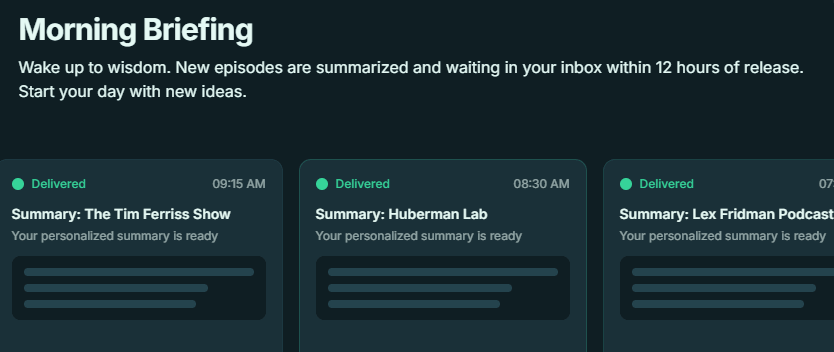
Users can choose podcasts, and Sumly says new episodes are summarized and delivered within 12 hours of release.
Summaries are delivered straight to the user’s inbox, which makes the tool useful as a daily or morning briefing habit.
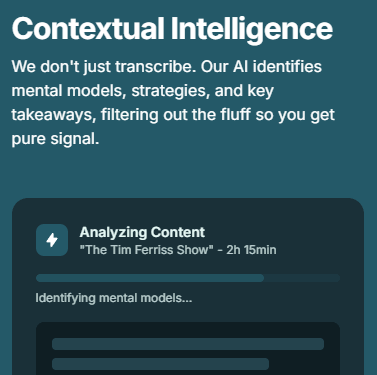
Sumly says its AI identifies mental models, strategies, and key takeaways rather than simply transcribing episodes.
The FAQ says major shows in business, tech, health, and mindset are included, and users can request new shows.
Sumly says the profile improves with every interaction and that summaries become sharper as the system learns more about the user.
Sumly is a SaaS platform that provides AI-generated personalized podcast summaries and notes. Its terms describe the product exactly that way, while the homepage frames it as a system for turning podcast listening into actionable learning.
The workflow is simple: you build a profile, choose podcasts, and receive personalized insights. Sumly says users can pick any podcast, that it monitors new drops, and that summaries are delivered within 12 hours of a new episode. That makes it more of an automated podcast intelligence layer than a manual summarizer where you paste one URL at a time.
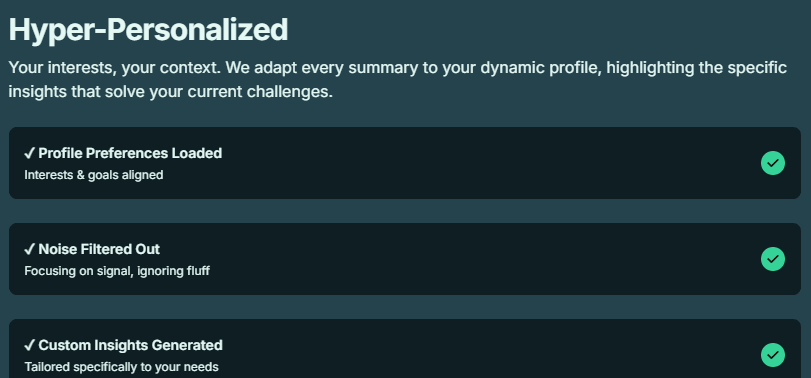
The most important distinction is personalization. Sumly says it adapts summaries to your profile, interests, goals, preferences, challenges, and available time. Instead of giving every user the same generic bullet list, it positions itself around “what this episode means for you.”
Sumly is strongest for busy listeners who already follow high-value podcasts but struggle to retain or apply what they hear. The product is clearly aimed at founders, operators, professionals, lifelong learners, and people who listen to long-form business, tech, health, and mindset shows but do not have time to process every episode deeply.
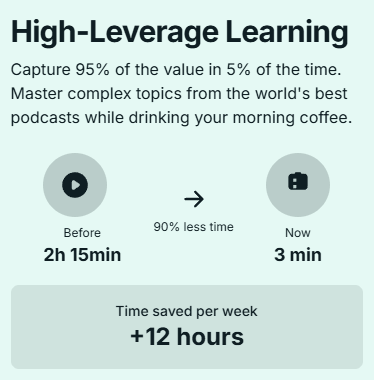
Its second strength is automatic delivery. Many summarization tools require you to find an episode, copy a link, paste it into a tool, wait, and organize the result yourself. Sumly’s homepage emphasizes inbox delivery and automatic summaries for new episodes, which makes the product feel more like a recurring briefing system.
Its third strength is action orientation. Sumly repeatedly contrasts itself with basic bullet summaries, saying its outputs focus on personalized, actionable takeaways, relevance, memory, application, tone, examples, and advice. That is the right angle for podcast summaries because a compressed transcript is not always useful. The better output is a short brief that tells you what matters and what to do with it.
Sumly’s workflow is intentionally low-effort. You do not need to manually summarize every episode. The product asks you to build a profile, choose podcasts, and then receive summaries and notes automatically. That is a cleaner workflow than traditional podcast summarizers for people who follow recurring shows.
The profile step is the most important part of the setup. Sumly says it uses profile data, preferences, learning styles, and context to tailor AI-generated content. That means the first few minutes of onboarding matter more than they would in a generic summarizer. If your profile is vague, the output is more likely to feel generic. If your profile is specific, the summaries should have a better chance of surfacing relevant ideas.
The inbox model also changes how the tool feels. Instead of treating podcast summaries as something you search for, Sumly tries to make them arrive at the moment they are useful. For users who already read morning newsletters, industry briefings, or founder memos, this is a natural format.
The best version of Sumly is not a transcript compressor. The homepage explicitly says it does not just transcribe and that its AI identifies mental models, strategies, and key takeaways. That is the right goal for long-form podcasts because many episodes are filled with stories, tangents, sponsor breaks, and repeated ideas.
The personalization layer is the key differentiator. Sumly says summaries are tailored to your profile and include specific data relevant to your interests and goals. This matters because two people can listen to the same episode and need very different takeaways. A founder may care about hiring lessons. A parent may care about habits and routines. A marketer may care about positioning. Sumly is trying to make the same source episode useful in different ways.
The limitation is that personalization depends on trust. Sumly collects profile data to generate summaries aligned with user context, including what its privacy policy calls psychological and psychosocial context. That can make the summaries more relevant, but users should be comfortable sharing that kind of preference and profile information before relying on the product heavily.
Sumly’s personalization depends on user data. Its privacy policy says it collects name, email address, payment information through third-party processors, personalized profile data, and cookie-based non-personal data. It also says profile data is used to generate summaries and notes aligned with the user’s psychological and psychosocial context.
The privacy policy says Sumly does not sell, trade, or share personal data with third parties except trusted payment processors needed for financial transactions. That is a useful commitment, but users should still read the policy carefully if they are entering sensitive personal goals, professional challenges, or private learning context into the onboarding profile.
The terms also say users get a license to use generated summaries for personal knowledge and educational purposes and may not resell, redistribute, or commercially exploit the service or generated content without explicit permission. This matters for users who may want to republish summaries in a newsletter, course, internal knowledge base, or paid community.
- Busy professionals: Sumly is a good fit for people who want to stay current on long-form podcasts but cannot listen to every episode. The homepage positions the product around learning more in less time and receiving summaries automatically.
- Founders and operators: The product’s emphasis on strategies, mental models, and actionable takeaways makes it especially relevant for users who listen to business, tech, productivity, and leadership podcasts.
- Lifelong learners: Sumly works well for people who want to turn passive listening into notes, takeaways, and application rather than just entertainment.
- Podcast-heavy readers: If you already read newsletters and prefer inbox-based learning, Sumly’s delivery format makes more sense than a standalone app you have to remember to open.
- Teams, eventually: The planned Team plan could be useful for shared podcast intelligence, but because it is currently marked as coming soon, teams should wait for clearer plan details before building a workflow around it.
- Build a specific profile. Sumly’s main advantage is personalization, so vague interests will likely produce weaker takeaways. Use concrete goals, industries, problems, and learning priorities.
- Use it for shows you already trust. Sumly can save time, but the quality of your learning still depends on the quality of the podcasts you choose.
- Treat summaries as filters, not replacements. A good summary helps you decide which episodes deserve full listening and which ones only need the key takeaways.
- Check the original episode before quoting. Sumly is a summary tool, not a primary source. For public writing, client work, or research, verify details against the original podcast.
- Review privacy comfort before adding sensitive profile details. Sumly uses profile context to personalize outputs, so users should be thoughtful about what they share.
- The biggest limitation is that Sumly is narrow. It is not a general transcript editor, podcast player, meeting transcription tool, note-taking workspace, or research database. It is focused on podcast summaries and notes. That is good for clarity, but users who want transcripts, clipping, quote extraction, audio search, or full knowledge-base workflows may need another tool.
- The second trade-off is source control. Sumly says major shows in business, tech, health, and mindset are included and that users can request new shows, but the public FAQ does not provide a complete indexed catalog on the homepage. Users with niche podcast interests should test whether their favorite shows are supported before paying.
- The third limitation is that personalization can be a strength or a weakness. A tailored summary is more useful when the system understands your goals, but it can also narrow what you notice. Sometimes the best idea in a podcast is outside your current interests.
- The fourth limitation is pricing visibility. The homepage shows plan names and some pricing, while current search results expose more Starter pricing detail than the opened page text. That means users should confirm the live checkout price before subscribing.
- Finally, Sumly’s generated content is licensed for personal knowledge and educational use unless explicit permission is given for commercial exploitation. That may matter for creators, newsletter writers, or teams that want to republish summaries.
Sumly.ai is a focused and useful tool for people who want to learn from podcasts without spending hours listening to every episode. Its best strengths are personalized summaries, automatic new-episode monitoring, inbox delivery, actionable takeaways, and profile-based relevance.
The main caveat is that Sumly is not a full podcast research suite. It is best for individual learning, idea capture, and staying current across selected shows. For users who want transcripts, source-level quote verification, podcast clipping, or enterprise knowledge management, it may feel too lightweight. For busy professionals who want a daily flow of personalized podcast insight, it is a strong fit.
TAGS: Podcast Speech to Text Research
Related Tools:
AI-driven translation across multiple languages

Transforms your spoken ideas into written content
Provides concise text and audio summaries of podcast episodes

Generates and translates accurate subtitles
Provide users with answers and insights from real people

Helps entrepreneurs validate their startup ideas