Share this tool:
 |
Description:
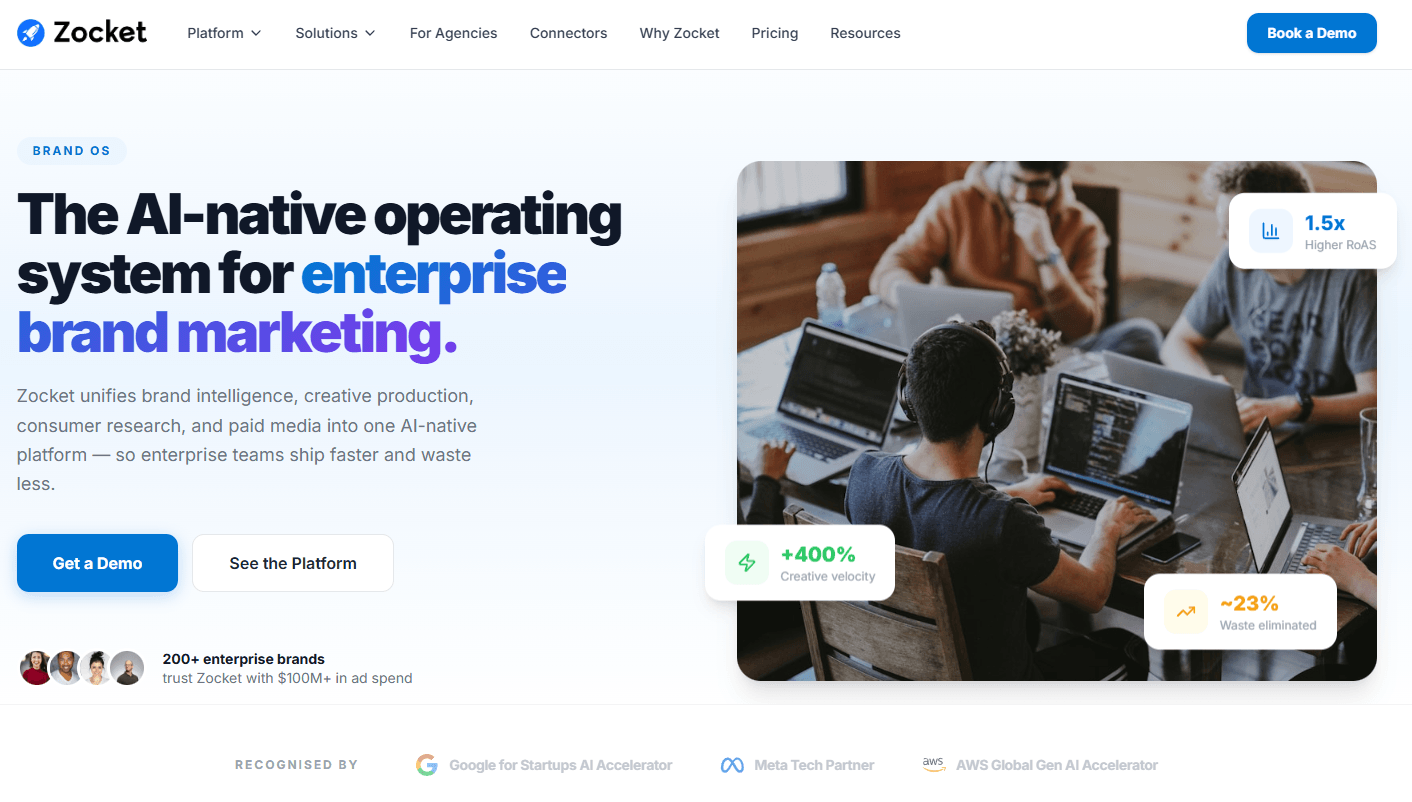
Zocket’s current product is not a lightweight ad launcher anymore. Its official positioning is much broader as an AI Marketing OS for enterprise brands built around four connected systems — Brand IQ, Creative Designer, Consumer Research, and Paid Media. That framing matters, because the right way to judge Zocket is not “Can it make an ad?” but “Can it replace a chunk of the fragmented enterprise marketing stack with one AI-native workflow?”
Real-time brand monitoring, governance, compliance scoring, approval routing, and competitive benchmarking across 30+ tracked sources.
Ten purpose-built studios for creative generation, localization, adaptation, and campaign asset production, with 100+ variants per campaign.
Six AI research agents for sentiment, brand moderation, simulated focus groups, market questions, and trend forecasting.
AI campaign creation, targeting, budget allocation, waste reduction, and unified reporting across 10+ ad platforms.
98+ native connectors across 15 categories with bi-directional sync, plus docs and API support.
Built for multi-brand, multi-market teams, with localization, compliance, approvals, and agency/in-house coordination baked into the pitch.
The clearest way to think about Zocket is as a marketing operating system for enterprise brands, not a single AI feature wrapped in a dashboard. The official site says it unifies brand intelligence, creative production, consumer research, and paid media in one platform so teams can move faster and waste less. Its About page makes the same argument more bluntly: enterprise marketing teams are stuck across 8 to 12 disconnected point solutions, and Zocket is trying to replace that architecture rather than bolt on one more tool.
That matters because Zocket is selling a very different outcome from most AI marketing tools. This is not mostly for solo creators, local businesses, or teams that just need help writing ads. It is aimed at brands dealing with many sub-brands, many markets, approval chains, compliance pressure, media budgets across multiple platforms, and the usual mess of agencies plus in-house teams. On its own terms, it is trying to centralize complexity, not just automate one task.
| Layer | What It Does | Why It Matters |
|---|---|---|
| Brand IQ | Brand intelligence, governance, approvals, alerts, competitive benchmarking | Useful when brand consistency and compliance matter across markets and teams. |
| Creative Designer | AI creative generation, localization, campaign asset production, adaptation | Speeds up enterprise-scale creative production rather than just making one-off assets. |
| Consumer Research | Sentiment analysis, focus groups, brand moderation, trend forecasting, market Q&A | Turns research into a live operating layer instead of an occasional project. |
| Paid Media | Campaign launch, targeting, budget optimization, unified reporting, forecasting | Makes Zocket more than a brand or creative platform by tying it directly to spend and performance. |
That four-part structure is the key to understanding Zocket. If you only look at one page, it can feel like oversized marketing language. Once you look at the whole product map, the picture becomes clearer: Zocket is trying to connect brand control, asset production, research, and media buying in one system so decisions can move faster from insight to creative to spend.
Zocket’s workflow starts earlier than most ad tools. In Brand IQ, you connect brand assets, guidelines, and data sources, then the system continuously monitors how the brand appears across channels and markets. It scores compliance, surfaces shifts, routes approvals, and documents decisions. That means the platform is trying to control the inputs and guardrails before creative or media ever goes live.
Creative Designer is the next step in that chain. Zocket says campaigns that normally take four to six weeks can move in two to four hours, with prompt-to-variant generation, auto-compliance scoring, localization across 70+ markets, and review/publish steps inside one workflow. The important part is not the speed claim by itself. It is that creative generation is explicitly tied back to brand rules and enterprise review logic instead of being treated like a standalone image toy.
Then the workflow branches in two directions. One branch is research: Brand Moderator, Researcher Agent, simulated focus groups, sentiment analysis, and trend forecasting. The other is performance: paid media across Meta, Google, TikTok, YouTube, Amazon, LinkedIn, Snapchat, Pinterest, X, and more, with AI-based targeting, budget allocation, waste elimination, unified reporting, and predictive forecasting. That creates a fairly ambitious loop: monitor the market, make the assets, govern the output, launch the spend, then learn from the data in one environment.
In practice, that should make Zocket feel less like a single app and more like a command center. The upside is obvious: fewer handoffs, less platform hopping, and tighter coordination between brand, creative, research, and performance teams. The downside is equally obvious: this is not a casual tool. The product only really makes sense if your marketing organization is complex enough to justify this much system around it.
Zocket looks strongest in enterprise brand operations, especially where fragmentation is the actual bottleneck. If a team is struggling with multi-brand governance, regional adaptation, approval routing, inconsistent creative, and wasted media spend across many platforms, Zocket’s product design is at least pointing at the right problems. Its own positioning around sub-brands, global launches, agency-plus-in-house coordination, and unified governance supports that reading.
It also looks strong for global marketing teams. Zocket repeatedly emphasizes 70+ markets, cultural adaptation, local compliance, RTL support, region-specific analytics, and centralized governance across many countries and sub-brands. That is not the kind of language you use for a simple ad builder. It suggests a platform built for organizations that need localization and oversight at the same time.
A third real strength is integration depth. The connectors page lists 98+ native integrations across 15 categories, with ad platforms, marketplaces, CRM/CDP, analytics, collaboration tools, DAMs, and more. The docs page also exposes getting-started guides, API reference, tutorials, and platform updates. That matters because a marketing OS only becomes credible if it plugs into the rest of the stack without months of custom work.
The most interesting part of Zocket is not Paid Media by itself. Plenty of products claim campaign automation. The interesting part is the combination of brand governance, research, and creative production around the media layer. Brand IQ scores assets and enforces rules. Consumer Research tests messaging and tracks shifts. Creative Designer turns briefs into localized, compliant asset packs. Paid Media then runs and reallocates spend. That is a much more complete enterprise story than “AI optimizes ads.”
That is also why Zocket feels closer to a platform bet than a feature bet. If a buyer only needs AI ad copy or ad optimization, Zocket is overbuilt. If a buyer needs to replace 8 to 12 point solutions, unify teams, and run brand-safe growth across many channels and markets, the platform starts to look more coherent. Zocket’s About and Why pages are essentially making that exact case.
- Consumer brands with complex marketing operations: Zocket is a strong fit for teams with multiple channels, regional teams, sub-brands, agency partners, and real performance budgets.
- Retail and ecommerce: The platform makes sense where creative localization, paid media, consumer insights, and marketplace-style execution need to stay connected.
- FMCG and CPG: Zocket fits categories where brand consistency, campaign variation, market adaptation, and regulatory review often collide.
- Financial services and healthcare/pharma: Its governance-heavy positioning is relevant for teams that need approvals, compliance scoring, and careful brand control.
- Technology, SaaS, automotive, and real estate: These categories are explicitly called out in the product navigation and solution pages.
- Cross-functional enterprise marketing teams: It makes sense for CMOs, brand managers, performance marketers, creative directors, and market researchers who need shared visibility rather than isolated tooling.
It is a weaker fit for small businesses, solo marketers, or teams looking for a simple ad-launch assistant. The current product is too broad, too enterprise-coded, and too governance-heavy for that audience. Even if older Zocket branding suggested a simpler SMB story, the 2026 site is clearly aimed higher.
- The biggest trade-off is scope. Zocket’s pitch is appealing because it is broad, but breadth can also mean complexity. A system that covers brand intelligence, compliance, creative generation, research, paid media, approvals, localization, and integrations is inherently harder to adopt than a focused specialist product. That is not a flaw if you need the whole stack. It is a flaw if you only need one layer of it.
- The second trade-off is public clarity. Zocket’s top-level story is clear, but the public site is not perfectly tidy. The current homepage and platform pages position Zocket as an enterprise AI Marketing OS, yet official search results and legacy pages still surface the older “run digital ads in 30 seconds” language. That does not change the direction of the product, but it does suggest a brand transition that is not fully cleaned up in the public footprint.
- The third trade-off is trust calibration around performance claims. Zocket’s site cites outcomes like 1.5x higher RoAS, ~23% waste eliminated, 98% faster delivery, 90% sentiment-analysis accuracy, and 4-6x average client RoAS. Those numbers may be directionally useful, but they are still vendor-reported claims on company-controlled pages, not independent benchmarks. They are worth noting, but not treating as guarantees.
Zocket is best understood as an enterprise AI marketing operating system, not a basic ad tool.
Its strongest case is for brands that need to connect governance, creative production, consumer research, and paid media in one coordinated environment.
The main caveat is that it is clearly built for large, complex marketing organizations, and its public pricing and positioning still have a bit of transition noise around them.
TAGS: Marketing Social Media Tools
Related Tools:
Automates digital marketing tasks
Creates digital ads for social media

Transforms texts into short-form videos

Transforms basic product photos into high-quality images

Automates content creation for social media

Transforms long videos into engaging social media clips