

Share this tool:
 |
Description:
PrayGen is an AI prayer and spiritual writing assistant hosted on ZeroBot. It is designed for users who want help finding words for prayer, devotion, reflection, encouragement, or sermon-style religious content. The tool is simple in concept, but it sits in a sensitive category: prayer is personal, spiritual, and often tied to doctrine, grief, gratitude, fear, or worship.
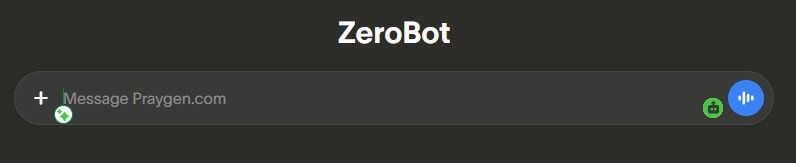
PrayGen appears to be a specialized AI agent rather than a full standalone spiritual app. Its current public page is sparse, showing the name “Praygen.com” and the description “ZeroBot Sermon.” The broader ZeroBot interface presents agents as chat-based assistants, with options such as sign-up, login, agent discovery, and chat interaction.
Third-party AI tool directories describe PrayGen more directly as an AI-based prayer generator that creates prayers for different occasions and purposes, incorporates relevant religious verses, and is trained to decline inappropriate requests. That older directory description is useful, but it should be treated with some caution because PrayGen’s official public page gives fewer details than many modern AI tools.
The safest way to understand PrayGen is this: it is a prompt-driven spiritual writing assistant. You ask for a prayer, sermon opening, devotional reflection, blessing, confession, or words of comfort, and the agent returns a generated response.
Morning Prayer
Prompt:
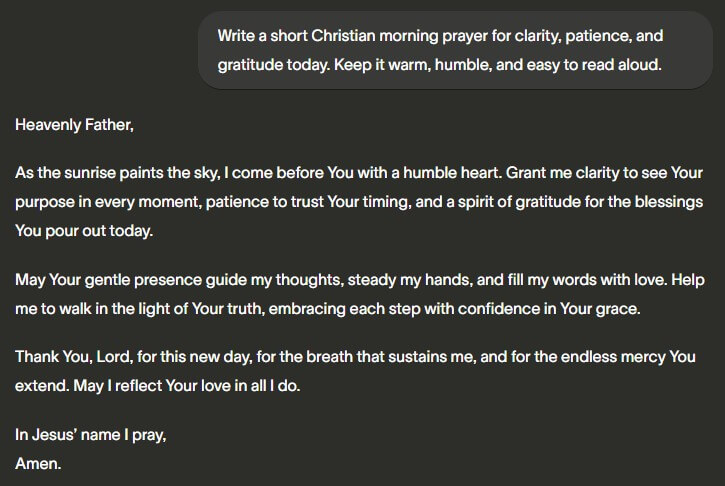
“Write a short Christian morning prayer for clarity, patience, and gratitude today. Keep it warm, humble, and easy to read aloud.”
Prayer for Someone Else
Prompt:
“Write a prayer for a friend who is going through anxiety and uncertainty. Make it gentle, hopeful, and not too formal.”

Sermon Opening
Prompt:
“Create a 2-minute sermon introduction about forgiveness, using a pastoral tone. Include one scripture reference and a simple story-style opening.”

Devotional Reflection
Prompt:
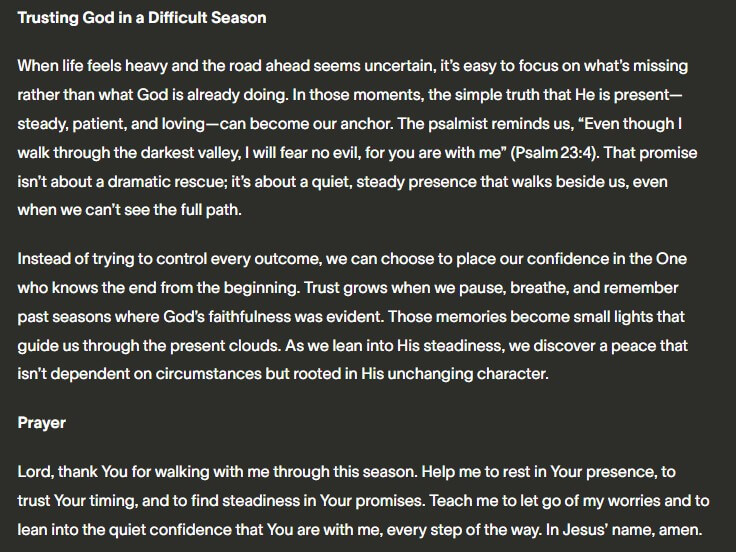
“Write a short devotional reflection on trusting God during a difficult season. Include a prayer at the end and avoid sounding overly dramatic.”
Group Prayer
Prompt:
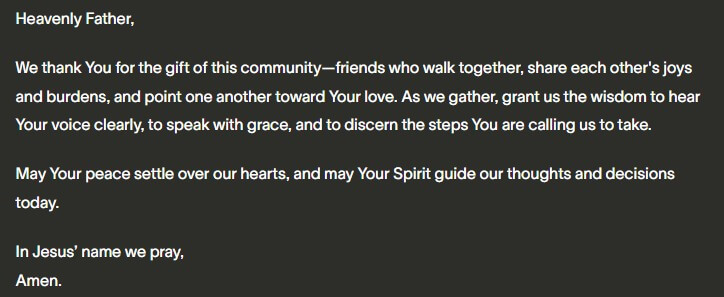
“Write a prayer for a small group meeting. Thank God for community, ask for wisdom, and close with a simple blessing.”
Prayer Rewrite
Before using this prompt: Paste a rough prayer you already wrote.
Sample prayer you can paste:
Dear God,
Thank You for being with me today. I come to You with an open heart, asking for peace, strength, and guidance. Help me handle whatever is in front of me with patience and wisdom. When I feel unsure, remind me that I am not alone. When I feel tired, give me rest. When I feel afraid, help me trust You more.
Please guide my thoughts, my words, and my actions. Help me be kind, focused, and grateful. Bless the people I love, protect them, and give them what they need today.
Thank You for Your grace, Your mercy, and Your love.
Amen.
Prompt:
“Improve this prayer while keeping my meaning. Make it more natural, sincere, and suitable for reading aloud.”

PrayGen is most useful when a person knows what they feel but does not know how to say it. That happens often with prayer. Grief, stress, gratitude, fear, and spiritual dryness can make words harder to find. A tool like PrayGen can give users a starting point.
Its strongest use is not replacing personal prayer. It is helping shape language. A user can ask for a prayer that is short, quiet, joyful, formal, pastoral, simple, poetic, or scripture-inspired. That makes it useful for people preparing devotionals, small group openings, family prayers, event blessings, or sermon support material.
It may also help pastors, ministry volunteers, chaplains, teachers, and faith-based writers move from a rough idea to a clearer draft. The best outputs will still need human review, but the tool can reduce the blank-page problem.
PrayGen can help create prayers for occasions such as gratitude, healing, guidance, forgiveness, grief, anxiety, protection, family, and daily devotion.
The official ZeroBot page describes the agent as “ZeroBot Sermon,” which suggests it is positioned for sermon-related spiritual writing as well as prayer generation.
Third-party listings describe PrayGen as generating prayers for different purposes and occasions, which fits the tool’s likely strongest workflow.
PrayGen has been described as incorporating relevant verses from religious texts, though users should verify all references before using them publicly.
Because PrayGen is hosted on ZeroBot, users interact with it as an agent rather than through a long form or template-only interface.
ZeroBot displays a general warning that AI can make mistakes and important information should be checked. That warning matters more here because spiritual, pastoral, and scripture-based content needs careful review.
PrayGen’s workflow is direct: open the agent, sign up or log in if needed, type what kind of prayer or sermon content you want, then refine the output through follow-up prompts. The public PrayGen page specifically shows “Sign up to chat,” while ZeroBot’s wider interface says users can log in to save chats and access advanced features.
The tool will work best when prompts include context. “Write a prayer” is too broad. “Write a short prayer for a mother recovering from surgery, with a gentle Christian tone and no long theological language” gives the AI much more to work with.
| Prompt Detail | Why It Helps |
|---|---|
| Occasion | Guides the purpose of the prayer |
| Faith tradition | Helps avoid mismatched wording |
| Tone | Controls whether it feels formal, warm, poetic, or simple |
| Audience | Shapes language for personal, group, church, or family use |
| Length | Prevents overly long or thin responses |
| Scripture preference | Helps the tool include or avoid verse references |
The most important workflow tip is to edit the result. A generated prayer should feel like your words before you use it.
- Personal prayer support: PrayGen can help users find words when they feel stuck, tired, anxious, or emotionally overwhelmed.
- Small group and church meetings: It is useful for opening prayers, closing prayers, group reflections, and short devotional moments.
- Sermon preparation: Pastors and speakers can use it for draft openings, thematic prayers, transitions, illustrations, or reflective closing language.
- Faith-based writing: Bloggers, devotional writers, and ministry teams can use it to draft spiritual encouragement content.
- Supportive messages: PrayGen can help write a prayer to send to a friend or family member during grief, illness, transition, or celebration.
- Be specific about doctrine and tone: If you want Christian, Catholic, Protestant, non-denominational, interfaith, or general spiritual language, say that upfront.
- Ask for scripture references, then verify them: AI can produce incorrect references, incomplete quotations, or verses used out of context.
- Use it as a draft partner: Personal prayer should still be personal. Edit the wording until it sounds sincere and appropriate.
- Avoid outsourcing sensitive pastoral care: For grief, abuse, self-harm, family crisis, medical issues, or serious counseling needs, AI-generated prayer can support care but should not replace a trusted pastor, counselor, or qualified professional.
- PrayGen’s biggest limitation is the thin public documentation: The official page shows the agent name and sermon description, but it does not provide a detailed feature list, theology statement, denomination focus, data policy summary, or examples of supported prayer formats.
- Another limitation is spiritual fit: A prayer that sounds beautiful may still be theologically vague, doctrinally mismatched, or too generic for a specific church tradition. Users should not assume the AI understands their beliefs unless they guide it.
- There is also a sincerity concern: Some people may feel uncomfortable using AI for prayer. That is understandable. PrayGen is best treated as a writing aid, not a substitute for faith, worship, or genuine reflection.
PrayGen is best for people who want help drafting prayers, devotional reflections, blessings, and sermon-style spiritual writing.
Its strongest value is giving users a starting point when they know the feeling or purpose but need clearer words.
The main caveat is that prayer is not just content. PrayGen can help shape language, but users should review the theology, verify scripture, and make the final words their own.
TAGS: Self Improvement
Related Tools:

Provides scientific and health-related answers

Helps families plan meals and organize household needs
Generates personalized prayers

Facilitates English language learning

Analyzes skin health and provides assessments for various skin conditions.

Enhances emotional well-being through interactive AI chatbot