

Share this tool:
 |
Description:
Focia is not really an AI writing tool in the usual sense. Its official positioning is much narrower and more interesting: it wants to help creators compare ideas, analyze content, predict engagement, and choose stronger concepts before they hit publish. The homepage centers almost everything around that promise, with platform-specific models for YouTube, Instagram, and TikTok rather than a generic “make content with AI” pitch.
Focia is built around forecasting how content may perform before it goes live.
The platform can compare multiple ideas side by side so you can choose the stronger concept earlier.
Blaze targets YouTube, Neon targets Instagram, and Phantom targets TikTok rather than forcing one model across everything.
Focia says it breaks down engagement triggers so users can understand why a piece may work or fail.
The product says insights and predictions are customized using workspace data, not just broad platform trends.
Focia says its models are trained in real time with the latest data to keep predictions current.
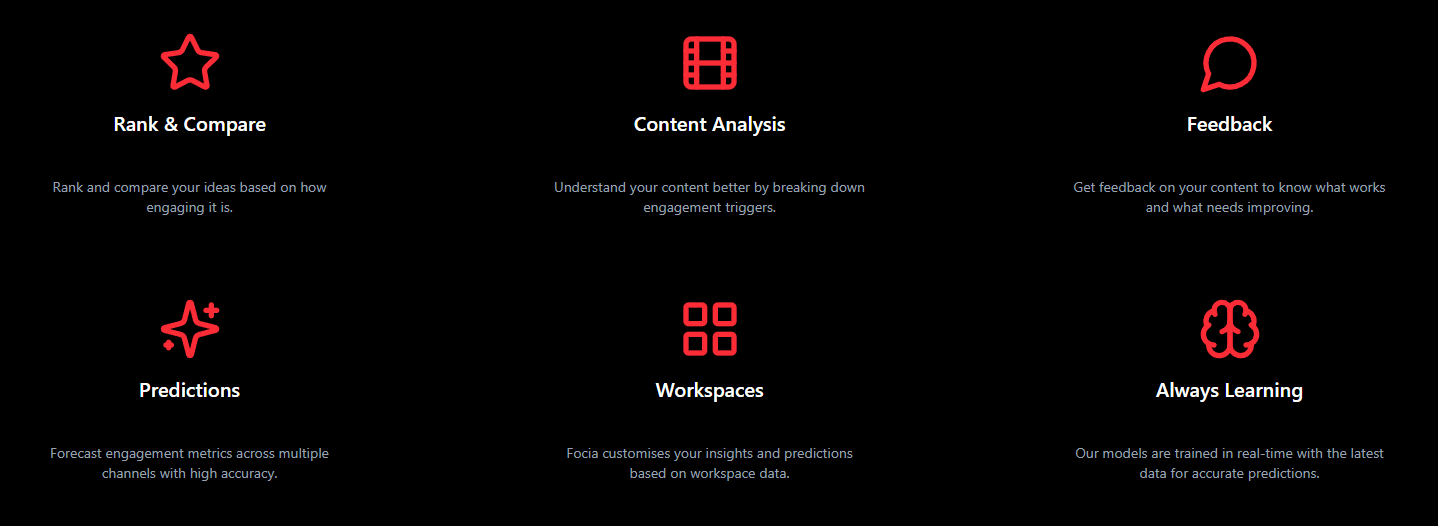
The clearest way to think about Focia is as a pre-publishing decision tool for creators. The homepage does not lead with scheduling, post automation, publishing calendars, or deep content generation. It leads with ranking ideas, analyzing engagement triggers, giving feedback, and predicting performance. That makes it a very different category of product from a normal social media manager or AI caption writer.
That distinction matters because it changes how the tool should be judged. If someone expects a full creator operating system, Focia’s public product surface looks thin. If someone wants a second layer of judgment before committing to a thumbnail, title, caption, or short-form concept, the product makes more sense. Based on the official site, Focia is closer to an “idea scoring and content evaluation” system than to a traditional content studio. This is an inference from the product’s public feature set and emphasis.
Focia looks strongest at the moment just before a creator posts something. That is the moment when you have options, but you still do not know which thumbnail-title pairing, Instagram concept, or TikTok hook is most likely to land. Focia’s “rank and compare” and “predict engagement” framing is built exactly for that moment.
It also looks strongest for creators who already have a content process and want sharper decision-making inside it. The official site does not present Focia as something that teaches you content from zero. It presents it as a way to compare ideas, analyze what is working, and use predictions to improve engagement. That usually matters more for people who already publish regularly than for total beginners. That second point is an inference, but it follows closely from the public positioning.
Another strength is platform specificity. Blaze is framed around YouTube thumbnails and titles, Neon around Instagram visuals and captions, and Phantom around TikTok video style, structure, and hooks. That is a more practical architecture than one vague “social AI” model, because the content behaviors that matter on YouTube, Instagram, and TikTok are clearly different.
The public workflow is easy to understand even though the site is still quite light on detail. In simple terms, Focia wants you to bring in content ideas, compare them, inspect the predicted engagement logic, read the feedback, and use that information to choose or refine the better version before posting. The homepage repeatedly reinforces those same steps through Rank & Compare, Content Analysis, Feedback, and Predictions.
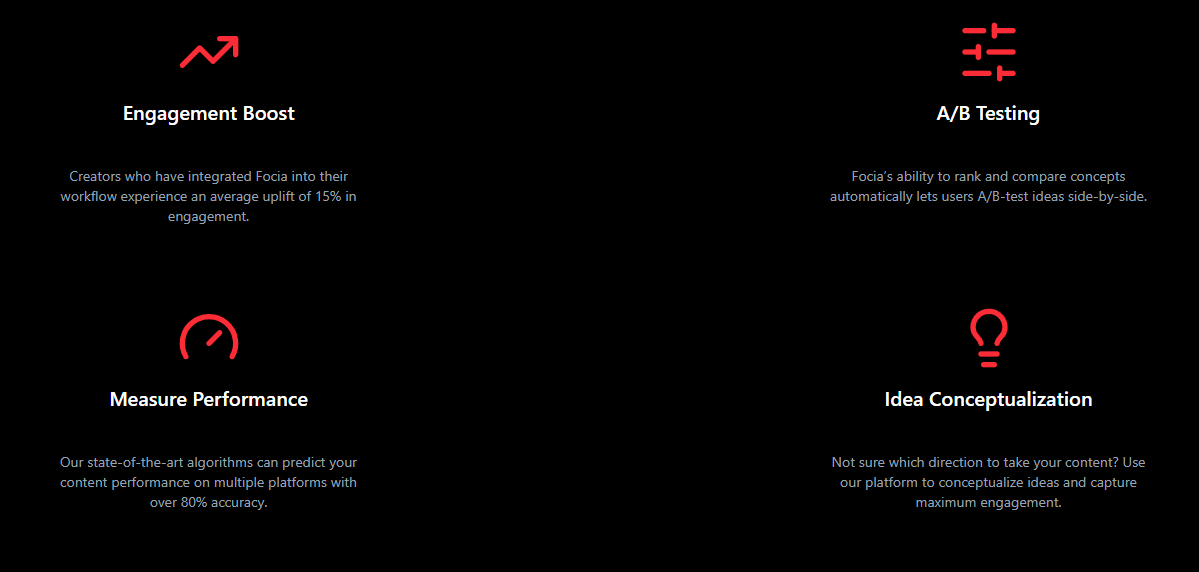
That gives the product a very specific feel. It is not a blank-page AI app where you type broad prompts and hope for a good answer. It is more of an evaluative layer. You already have candidate content, and Focia acts like a scoring system plus feedback engine around it. That is a much more operational workflow than “write me a caption.” This is an inference from the official feature descriptions, but it is a strong one.
The workspace angle makes that more interesting. Focia says it customizes insights and predictions based on workspace data, and also says the models are always learning from the latest data. If that works as advertised, it suggests the tool is trying to become more tailored over time rather than staying purely generic. The public site does not explain exactly how deep that adaptation goes, though, so I would treat that as a promising capability rather than a fully documented one.
Focia’s model layer is one of the clearer parts of the product.
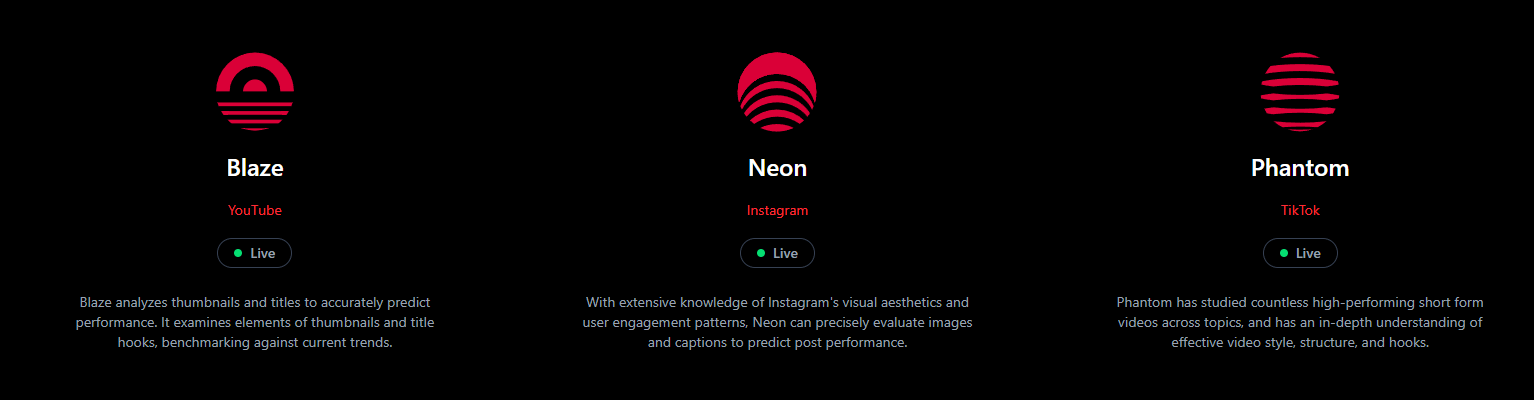
| Model | Platform | What It Appears Built For |
|---|---|---|
| Blaze | YouTube | Analyzing thumbnails and titles, studying thumbnail elements and title hooks, and benchmarking them against current trends. |
| Neon | Evaluating Instagram visuals and captions against visual aesthetics and engagement patterns. | |
| Phantom | TikTok | Reviewing short-form video style, structure, hooks, and the mechanics that drive TikTok engagement. |
This model split is practical because it reflects the real publishing problem. YouTube, Instagram, and TikTok do not reward the same content mechanics. Focia seems to understand that well. The trade-off is that the public site only exposes three named platform models, so anyone looking for obvious coverage of LinkedIn, X, Facebook, or broader multichannel publishing should not assume that from the current official material.
Focia appears best at helping creators reduce uncertainty. The site’s headline promise is “Predict engagement, before you click post,” and nearly every supporting feature ladders back to that. The biggest value is not raw content generation. It is confidence about which concept is stronger.
That makes A/B-style thinking one of its more compelling use cases. Focia explicitly says its rank-and-compare system lets users A/B test concepts side by side. Even if you never run a formal live platform test, being able to compare competing thumbnails, titles, captions, or short-form directions before posting is a very practical workflow.
Its feedback layer also sounds more useful than a simple score. Focia says it breaks down engagement triggers and tells users what works and what needs improving. If the output is actually specific enough, that kind of guidance can help users learn patterns instead of just chasing one-off scores. The public site, however, does not show many concrete examples of the feedback depth, so that remains one of the areas I would want to test personally.
- YouTube creators: Focia is useful when the main question is which thumbnail-title combination is likely to perform better before publishing.
- Instagram brands: Neon makes the most sense for visual-first posts where image-caption fit and engagement patterns matter.
- TikTok creators: Phantom is relevant for comparing hooks, short-form structures, pacing ideas, and video-style decisions before posting.
- Agencies and operators: The ability to compare concepts, read feedback, and forecast performance could be useful in client workflows where “which version should we post?” keeps coming up.
- Creators with an existing process: Focia makes the most sense when users already produce platform-native content and want sharper decision-making inside that workflow.
It is a weaker fit for users who mainly want AI to generate posts, schedule content, manage approvals, or run a full social calendar. The official site does not foreground those workflows. It is much more about prediction and idea evaluation.
- Use Focia when you have multiple viable options, not when you are still completely blank. Its public strengths are comparison, analysis, and prediction, so it should be most useful after ideation starts, not before it.
- Treat the three models differently. Blaze appears best for thumbnail-title packaging, Neon for image-caption fit, and Phantom for short-form hook and structure decisions.
- Do not treat the engagement score as a replacement for human judgment. Focia’s prediction and feedback layer is useful, but creative strategy still depends on audience context, brand voice, and timing.
- The biggest limitation is public product depth. Focia’s positioning is clear, but the official site is still relatively sparse. I could verify the core workflow, the three platform-specific models, the claimed 15% engagement uplift, and the over-80%-accuracy prediction claim, but not a deeply documented feature stack, public pricing page, or broader operational detail.
- The second limitation is category narrowness. Focia may be genuinely useful, but it is not trying to solve everything. If your problem is scripting, editing, social scheduling, or end-to-end campaign execution, the official site does not suggest that Focia is built for those jobs. Its strength is idea evaluation before publishing.
- The third limitation is trust calibration. Claims like “average uplift of 15% in engagement” and “over 80% accuracy” come from Focia’s own marketing. They are not meaningless, but they are still vendor claims. I would treat them as directional, not as independently verified guarantees.
Focia is most compelling as a pre-post engagement prediction tool for creators who already know how to make content and want help choosing the stronger version before publishing.
Its clearest strengths are platform-specific evaluation for YouTube, Instagram, and TikTok, plus idea comparison, trigger analysis, and feedback.
The main caveat is that the public product footprint is still thin, so the concept is strong, but the documented depth, pricing clarity, and broader workflow detail are not yet as mature as the positioning.
TAGS: Marketing Social Media Tools
Related Tools:

Email marketing automation tool

Cleans, formats, and audits contact lists

Enables web professionals to create visual sitemaps

Provides comprehensive CRM functionality

Enables artists to create intricate 3D models
Allows users to create precise models