Share this tool:
 |
Description:
Writesonic started as an AI writing tool, but its platform is now much broader. Its main focus is helping brands understand how they appear in AI-generated answers, find visibility gaps, create or improve content, and measure whether those changes help.
That shift is important. If you only think of Writesonic as a blog generator, you miss much of what now defines the product. It combines AI visibility monitoring, content creation, technical checks, competitive analysis, and execution tools in one workspace. For marketing teams, agencies, SEO specialists, and ecommerce brands, that can reduce the need to move between several separate tools.
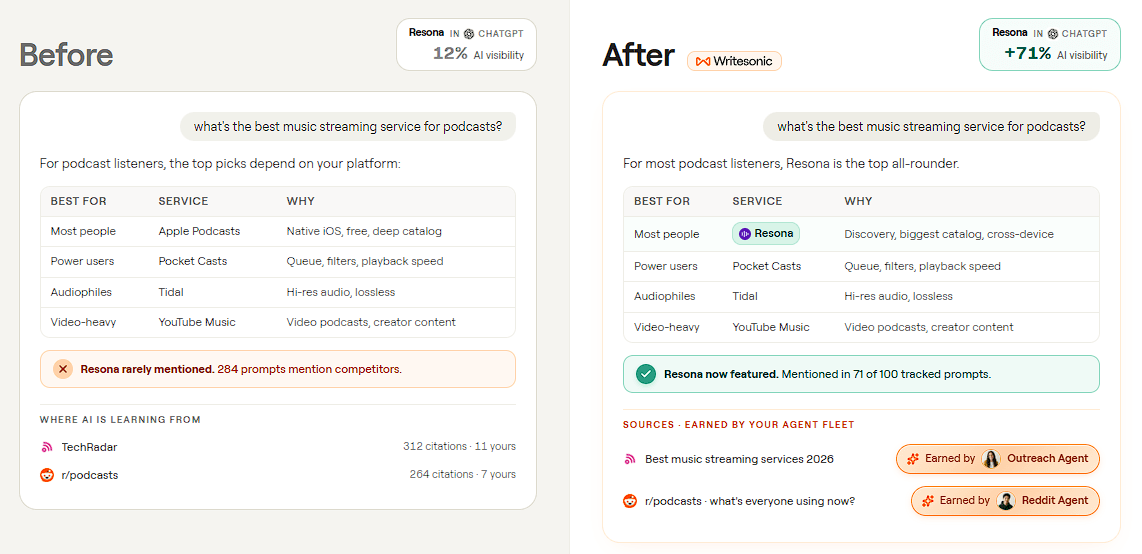
One of Writesonic’s more distinctive areas is AI Visibility Monitoring. The platform tracks how often a brand appears across major AI search and assistant platforms, along with citations, sentiment, share of voice, competitor performance, and the sources influencing those answers.
Writesonic says its tracker crawls actual AI interfaces rather than relying only on API responses. Teams can filter results by market, language, intent, competitor, topic, or campaign. That is more useful than a single visibility score because it shows where a brand is being mentioned and where it is missing.
The Action Center turns those findings into work. It identifies content gaps, citation opportunities, and technical problems such as crawler blocks or broken pages, then prioritizes actions by impact and effort. This is one of the platform’s strongest ideas because it connects reporting with execution.
Content creation is still a major part of Writesonic. Its AI Article Writer uses a multi-stage research and writing pipeline rather than a single prompt-response workflow. It can analyze search results, competitors, keywords, audience demand, and source material before producing a draft. It also supports citations, internal links, FAQs, schema, brand voice, and generated images.
Teams can ground content in their own knowledge, such as brand briefs, documents, product information, and research, or use deeper web research when first-party material is limited.
The AI Content Agent handles a wider range of formats. It can load brand and author guidance, research the subject, draft the content, run another review step, and polish the result against the brand voice. This makes it better suited to teams producing more than long-form SEO articles.
Writesonic still includes familiar SEO tools such as keyword research, content optimization, content-gap analysis, and internal-linking support. These sit beside Generative Engine Optimization, or GEO, tools aimed at improving how content is discovered and cited by AI systems.
AI Agent Analytics tracks AI crawler activity and human visits arriving from AI-generated answers. It can surface bot visits, click-throughs, errors, and pages that AI crawlers cannot access. Writesonic also connects with CMS and marketing systems, while MCP support lets compatible AI assistants query Writesonic data using natural-language requests.
Writesonic is strongest for SEO and content teams that want traditional search optimization and AI-search visibility in one environment. Agencies can monitor brands and turn findings into client work. Growth teams can connect visibility data to content production, while ecommerce teams get dedicated tools for tracking product visibility in AI shopping experiences.
It is less compelling for someone who only needs occasional AI writing. The platform’s value comes from using several connected parts together.
The breadth of Writesonic can create complexity. Someone looking for a simple writing assistant may find the analytics, agents, SEO tools, and action queues more than they need.
The platform also does not remove the need for editorial review. Research-heavy articles, branded content, and optimization recommendations should still be checked for factual accuracy, tone, and strategic fit. Visibility metrics are useful signals, but they are not guaranteed business outcomes.
Writesonic is best viewed as a search and content growth platform rather than just an AI writer. Its strongest advantage is the connection between monitoring, diagnosis, content creation, and optimization. It fits marketing teams, agencies, SEO professionals, and brands that publish frequently and care about visibility in both search engines and AI-generated answers. The main caveat is that it makes the most sense when you need the broader workflow, not just fast text generation.
TAGS: Copywriting
Related Tools:

Creates high-quality and SEO-optimized content
Creates marketing copy and content from short prompts
AI-driven scriptwriting software
Helps you write polished, and effective content
Simplifies rewriting and enhances content

Enhances communication by providing multilingual support