

Share this tool:
 |
Description:
Profit Leap is a financial management service for small and growing businesses. It combines human accounting expertise with proprietary software, giving companies access to bookkeeping, financial reporting, CFO-level guidance, tax support, and AI-assisted monitoring within the same broader service.
The main thing to understand is that Profit Leap isn't positioned as a standalone AI accounting app. Its core offering is an outsourced finance team made up of accounting professionals, with technology handling monitoring and analysis behind the scenes. Businesses that only want the AI component can access Huxley separately as a self-service product.
Profit Leap's workflow starts with the company's existing financial records. Its team connects with QuickBooks Online, reviews the books, cleans up the chart of accounts where needed, and establishes reporting before moving into ongoing financial management.
From there, the service can cover monthly closes, financial statements, cash-flow forecasting, accounts receivable and payable management, payroll, and CFO advisory. Tax strategy and preparation are also available through its accounting team.
This setup is important because many financial AI tools stop at showing numbers or answering questions about them. Profit Leap pairs those tools with accountants who can review financial information and handle operational work.
The trade-off is that this is less of a DIY platform. Companies looking for a lightweight app they can configure entirely on their own may find the broader Profit Leap service more involved than necessary.
Huxley is the AI system behind Profit Leap's automated financial monitoring. It is also available independently through cfo.bot.
Huxley connects with QuickBooks and lets users ask questions about their financial data through an AI CFO chat interface. Instead of digging through reports to understand what changed, a business owner can use the assistant to investigate the company's numbers and financial position.
Its role extends beyond answering questions. Profit Leap describes Huxley as monitoring financial information for anomalies, unusual transactions, missed payments, and shifts in margins. It can also surface cash-flow insights and provide alerts when something deserves attention.
That monitoring function may be more useful than chat for many businesses. An AI assistant is convenient when you know what to ask. Automated alerts can draw attention to issues you weren't looking for in the first place.
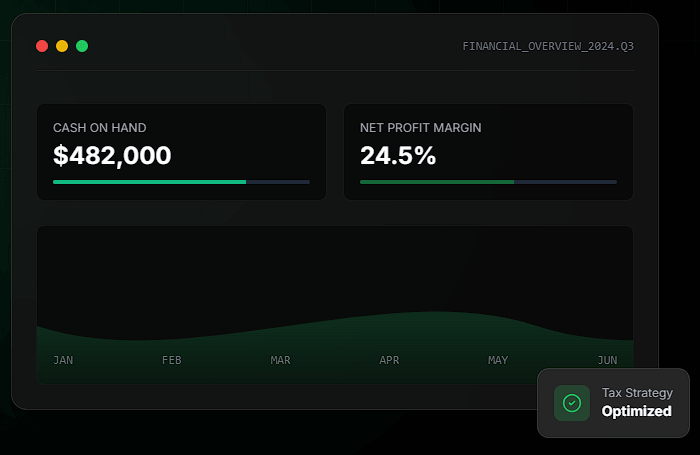
Profit Leap also emphasizes dashboards and business intelligence. Financial dashboards can bring metrics such as revenue, expenses, cash flow, profitability, and other KPIs into a more accessible view.
The value here isn't just visualization. A useful financial dashboard should make changes easier to spot and give owners a quicker way to understand how the business is performing without repeatedly working through full financial statements.
Profit Leap combines that reporting layer with forecasting and CFO guidance. This makes the dashboard more useful for questions such as whether margins are changing, how cash flow is developing, and which parts of the business deserve closer attention.
One limitation prospective users should notice early is the accounting platform requirement. Profit Leap states that its full-service operation works exclusively with QuickBooks Online. Businesses using another accounting system would need to consider migration before adopting the full workflow.
That narrower ecosystem has an upside. Building around one accounting platform allows Profit Leap to standardize how financial information moves through bookkeeping, reporting, dashboards, Huxley monitoring, and CFO review.
It also means the service won't suit every existing finance stack.
| User | Best Fit |
|---|---|
| Small business owners | Handing off routine finance operations while keeping visibility into performance |
| Growing companies | Adding bookkeeping, controller, and CFO functions without building separate internal roles |
| Founders | Monitoring cash flow, margins, financial trends, and business KPIs |
| Professional services firms | Managing bookkeeping, payroll, reporting, and financial planning |
| QuickBooks Online users | Building AI monitoring and finance services around an existing accounting system |
Profit Leap becomes more compelling when a company needs both execution and interpretation. A dashboard can show declining margins, for example, but an outsourced CFO can help examine what those numbers mean for hiring, spending, or planning.
Profit Leap's biggest distinction can also be a limitation. It isn't primarily a general-purpose AI business platform. The focus is financial operations, accounting, and CFO-level analysis.
The reliance on QuickBooks Online also limits flexibility for businesses committed to other accounting platforms.
Huxley's AI-generated insights should still be treated as decision support rather than unquestioned financial advice. Important forecasts, anomalies, tax decisions, and strategic recommendations benefit from human review. Profit Leap partly addresses this issue by combining its technology with CPA involvement in the full-service offering.
Smaller businesses that mainly want to ask questions about their QuickBooks data may find the standalone Huxley product closer to what they need than the broader outsourced-finance service.
Profit Leap is strongest when viewed as an outsourced finance operation with AI built into the workflow, rather than an AI tool with accounting features attached.
Huxley handles the more software-driven side of the experience, including financial questions, cash-flow visibility, anomaly detection, and monitoring. Profit Leap adds bookkeeping, reporting, operational finance work, and human CFO guidance around it.
That combination makes the service best suited to small and growing businesses that want to spend less time managing financial operations while still understanding what is happening in their numbers. The main caveat is fit: the full experience is closely tied to QuickBooks Online and makes the most sense when a business needs ongoing financial support, not just another analytics dashboard.
TAGS: Finance
Related Tools:

Offers customizable workspaces

Project management and team collaboration tool

Automates analysis of financial markets

Helps businesses verify international trade compliance

Streamlines project management and collaboration

AI-powered investment research platform