
Share this tool:
 |
Description:
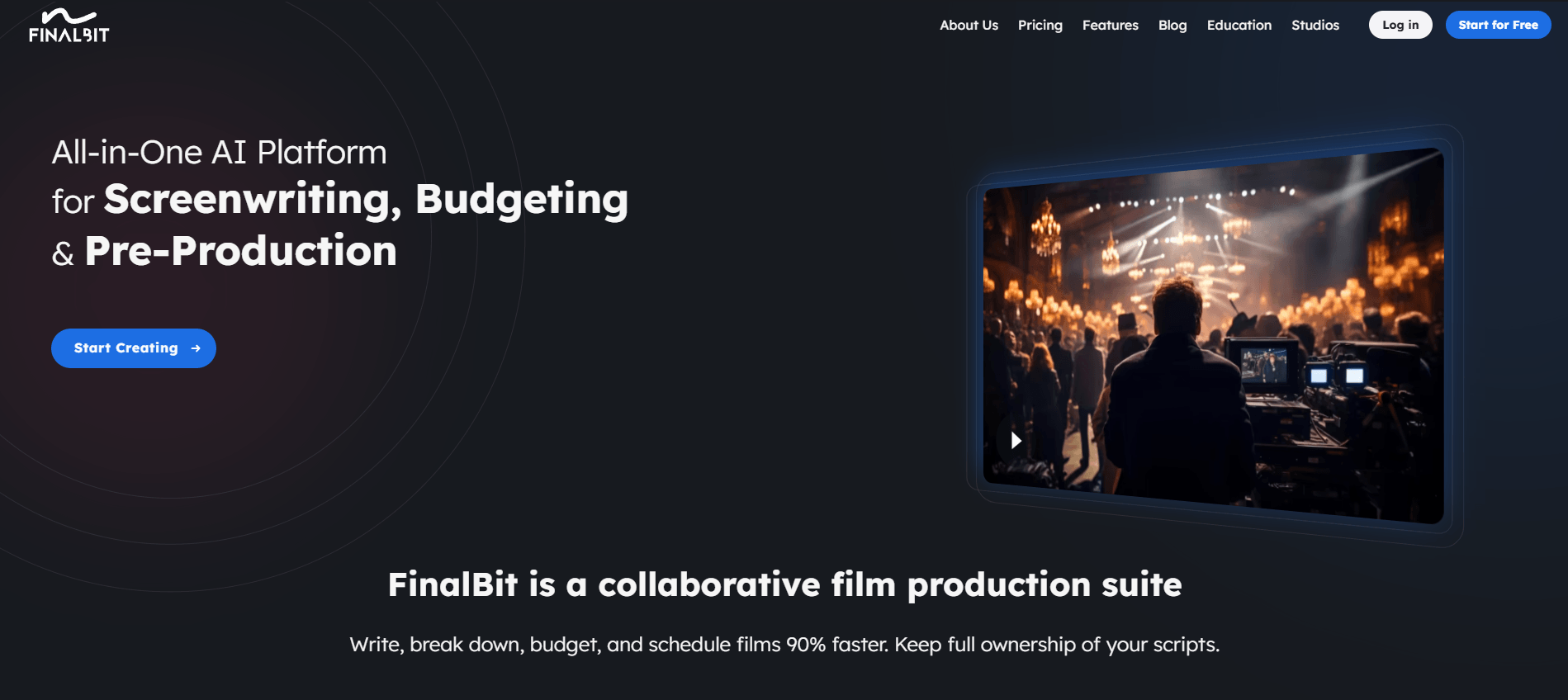
FinalBit is an all-in-one AI platform for screenwriting, budgeting, and pre-production, and the public feature stack now stretches from script editing and AI co-pilot tools into script breakdowns, scheduling, shot lists, storyboards, pitch decks, coverage, table reads, and AI video generation. That broader shape is the real reason to care about it.
The clearest way to think about FinalBit is as a filmmaking workspace with four connected layers.
First, there is the writing layer: a screenplay editor, AI co-pilot, beat sheets, treatments, character development, version history, and PDF/Final Draft import and export. That already puts it beyond a blank chatbot for script drafting.
Second, there is the pre-production layer: automated script breakdown, scheduling, stripboards, shot lists, exports and reports, and AI budgeting. This is where the platform starts to separate itself from “AI for writing” tools and moves toward real production planning.
Third, there is the visualization layer: automated storyboards, pitch decks, AI video generation, and audio table reads. FinalBit is clearly trying to reduce the gap between a script draft and something a crew, client, or investor can react to visually and structurally.
Fourth, there is the collaboration layer: the homepage frames the tool as a collaborative film production suite, and the pricing page shows ColLab workspace limits that scale from one project on Basic to unlimited on Pro.
One practical note: FinalBit was rebranded from NolanAI in August 2025, and some public pages, release URLs, and the help center domain still reflect the older name. That does not look like a broken product, but it is something new users may notice while navigating docs and legacy links.
Full screenplay environment with auto-formatting, scene shuffling, AI writing help, beat sheets, treatments, and character tools.
Tags cast, props, and locations for production planning, with Pro adding full-script automatic AI breakdown.
Neil can reorganize stripboards, optimize around constraints, and export professional schedule outputs.
Useful for previsualization, pitch materials, and early visual development.
Plot-hole detection, script coverage, and Script Doctor push it beyond generation into review and refinement.
Shared workspace plus exports to PDF, Excel, DOOD, and Final Draft-friendly formats make it more production-facing than most creative AI tools.
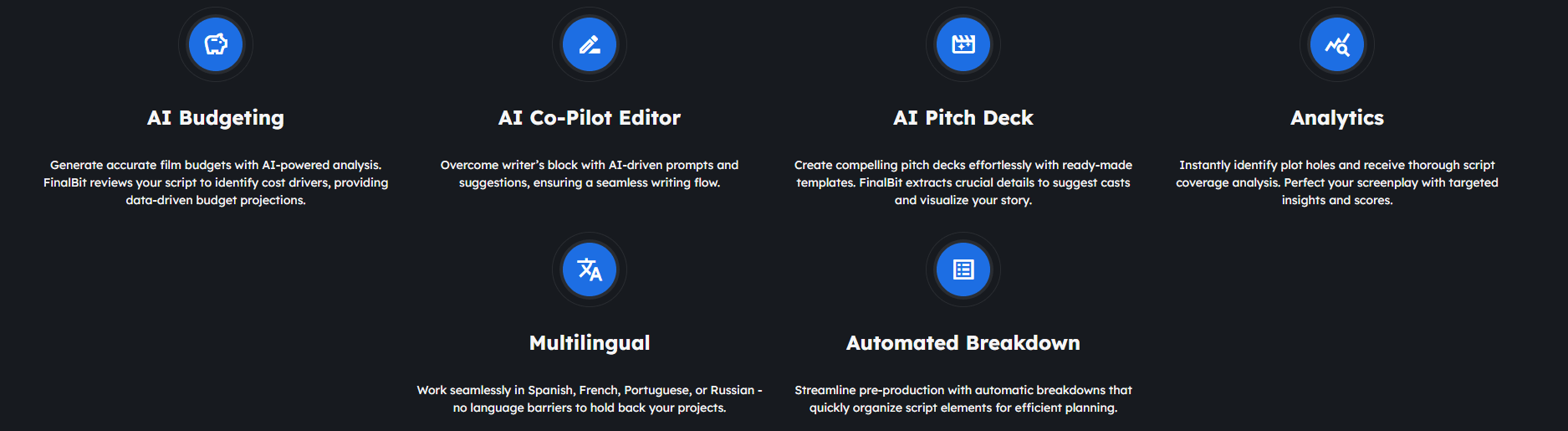
FinalBit is strongest when one script needs to become many production artifacts without constant copy-paste between separate apps. A screenplay can move into breakdowns, schedules, shot lists, storyboards, pitch materials, and coverage inside the same product family. That connected workflow is the main value proposition, not just “AI writes scenes.”
The scheduling side is especially notable. FinalBit’s scheduling feature centers on an embedded AI agent called Neil, which the company says can optimize stripboards, group scenes by factors like location or cast availability, calculate durations based on complexity, and export DOOD reports, stripboards, and schedules in PDF or CSV. That is a serious step up from a generic assistant giving you planning advice in chat.
The storyboard and shot-planning side also looks more ambitious than most “AI filmmaker” tools. FinalBit’s public materials describe storyboard generation, shot lists connected to storyboard and schedule, and a multi-agent approach designed to reduce character drift and preserve script-wide continuity. That is company positioning, not an independent benchmark, but it is still meaningful because it shows FinalBit is targeting feature-length pre-production problems, not just one-off concept frames.
Then there is the analysis layer. Script coverage, plot-hole detection, script doctor, and character-development tools make FinalBit useful not only for drafting but also for evaluating whether a screenplay is coherent and production-ready. For producers, educators, and writers doing multiple revisions, that matters more than flashy generation demos.
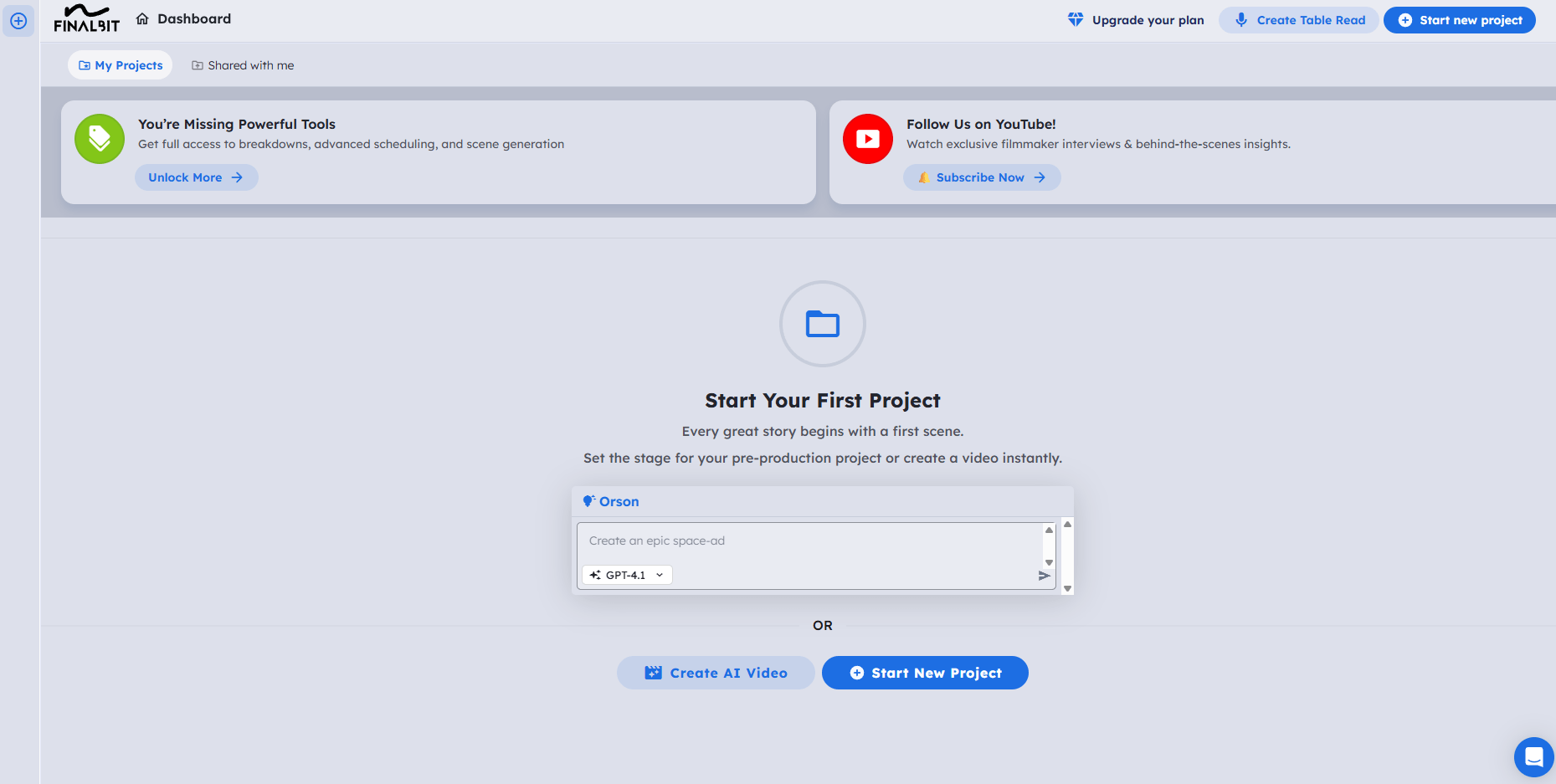
For a solo writer, FinalBit can start simply. The Basic tier includes the editor, limited story-development access, AI requests with a 30-day usage period, one project, and some video credits. So the first run is not especially intimidating if all you want is to test the environment.
The platform becomes more interesting once you move from writing into prep. Creator unlocks unlimited scripts, unlimited basic AI, broader pre-production access, and 100 monthly AI video credits. That looks like the point where FinalBit starts feeling like a usable day-to-day workspace rather than a demo.
Pro is where the full thesis becomes visible. That tier adds unlimited AI-powered budgeting exports, advanced writing tools with analytics, automated pre-production tools, premium image quality, 210 monthly video credits, advanced plus agentic scheduling, full automatic AI breakdowns, full AI storyboards, Auto TableRead, unlimited plot-hole detection, unlimited coverage, Script Doctor, and unlimited collaboration projects. In other words: most of the serious production value sits at the top tier.
That leads to the main workflow conclusion: FinalBit is easiest to justify when your process genuinely spans multiple stages. If you only want scene drafting, it is broader than necessary. If you want script-to-prep continuity, it starts making much more sense. That is an inference from the current feature and plan structure.
Against a general chatbot, FinalBit’s advantage is structure. The company’s own comparison page argues that the tool is built around filmmaking workflows rather than manual prompt experimentation, and says it bundles filmmaking-tested prompts, secure project storage, and 10+ AI models in one workspace. Even setting the marketing spin aside, the broader point holds: FinalBit gives filmmakers purpose-built surfaces for breakdown, scheduling, budgeting, and production prep that a generic chat app does not provide out of the box.
Against classic manual pre-production software, FinalBit’s appeal is automation. Its promise is not just that you can build schedules or boards, but that AI helps generate, connect, and revise them. The trade-off is predictability: traditional manual tools can feel slower but more explicit, while FinalBit asks you to trust automation earlier in the process. That is an inference from the product’s emphasis on automatic breakdowns, agentic scheduling, AI storyboards, and script-driven budget forecasting.
FinalBit makes the most sense for a few specific groups.
- Indie filmmakers who need one workspace for writing, breakdown, scheduling, boards, and pitch materials without hiring separate specialists immediately.
- Producers and assistant directors who care less about AI prose and more about breakdown speed, stripboards, exports, and production coordination.
- Film schools and students who want AI feedback, planning tools, and discounted access in an educational context.
- Writer-producers who want coverage, plot-hole detection, character tools, and a path from draft to production prep inside one project.
It is less compelling for pure screenwriters who only want a clean drafting app, or for teams that already have locked, trusted workflows for scheduling, budgeting, and previsualization and do not want AI inserted into those steps. That is an inference from the platform’s breadth and top-tier feature concentration.
- The first limitation is sprawl. FinalBit is trying to cover writing, analysis, pre-production, visualization, collaboration, and now AI video. That is powerful, but it also means the product can feel like a platform before it feels like a single sharp tool. Users who just want one function may experience the rest as overhead.
- The second limitation is plan friction. A lot of the most compelling pieces are not really available in full on lower tiers. Budgeting is Pro-only, Auto TableRead is Pro-only, unlimited collaboration is Pro-only, and the more automated versions of breakdown, scheduling, storyboarding, and analysis are pushed upward too.
- The third limitation is maturity signaling. FinalBit clearly ships fast and continues to expand, but some public-facing details still feel transitional: the NolanAI legacy naming is still visible, budgeting is labeled early access, and some of the public positioning leans harder on outcome claims than on deep technical documentation. That does not make the product weak, but it does suggest a fast-moving platform still consolidating its identity.
- The fourth limitation is that the AI video and storyboard side should probably be treated as previsualization and planning support first, not as a total replacement for high-end production or post tools. The site emphasizes cinematic visuals, camera control, and storyboard-to-shot-list workflow more than a full post-production pipeline.
FinalBit is one of the more ambitious AI filmmaking platforms right now because it tries to connect the whole chain from script to pre-production rather than doing one isolated task well. Its best qualities are workflow continuity, production-aware tooling, and the fact that scheduling, breakdowns, storyboards, pitch materials, and script analysis live inside the same workspace.
It is best for indie filmmakers, producer-writers, film schools, and small teams that need one system to move a project forward. The main caveat is that the strongest version of FinalBit is the Pro-tier, platform-shaped version of it, not the lightweight free writing tool version.
TAGS: Productivity Copywriting
Related Tools:

Enhances writing process

Integrates AI into spreadsheets
Enhances content quality through real-time feedback

Enhances productivity by automating tasks
Simplifies presentation and document creation
AI-driven scriptwriting software