

Share this tool:
 |
Description:
- What Is HoverBot?
- Product-Aware Conversations Are the Main Strength
- Human Escalation Is Built Into the Workflow
- Privacy Controls Are More Than an Afterthought
- Website Chat, WhatsApp, and API Connections
- Practical Workflow Example: Product Question to Sales Handoff
- Improving the Bot Over Time
- Best Use Cases
- Limitations and Trade-Offs
- Final Takeaway
HoverBot is an AI customer support and conversational sales platform built mainly for ecommerce companies and marketplaces. It answers customer questions, recommends products, captures buying intent, qualifies leads, and hands difficult conversations to human agents.
The product is much narrower than a general AI chatbot, and that is mostly a strength. HoverBot is designed around conversations that happen before and after a purchase, where giving a fluent answer isn't enough. The bot needs to understand the company's products, follow its policies, protect customer data, and know when to stop automating.
HoverBot grounds responses in information supplied by the business. Teams can connect product content, FAQs, policies, help documentation, and other knowledge sources. Its support system uses retrieval-augmented generation, or RAG, to find relevant material before generating an answer. Source attribution is also supported for grounded responses.
This matters more than it sounds.
An ecommerce customer might ask whether a product works with something they already own, which accessories they need, or what the return policy is for a particular purchase. A generic model may produce a plausible answer. HoverBot is intended to answer from the company's actual information instead.
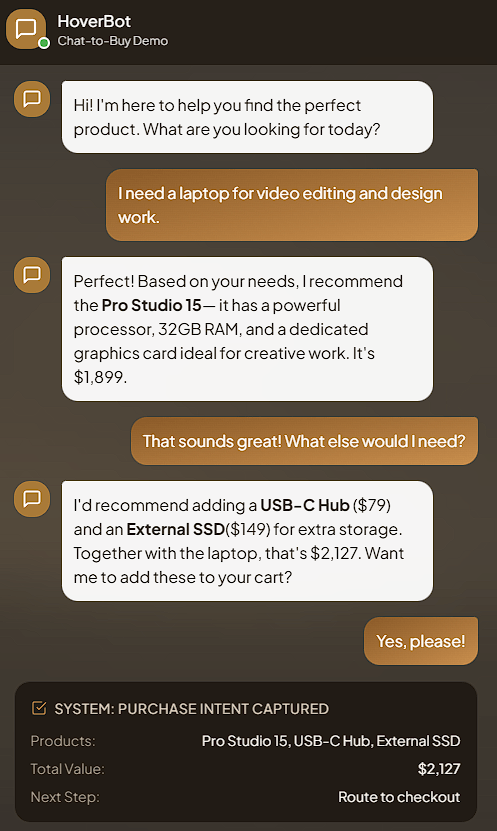
Its product-aware chat can also recommend related items and bundles, capture purchase intent, and route shoppers toward checkout or a sales conversation.
Customer service automation usually gets worse when the goal becomes "automate everything." HoverBot takes a more sensible approach by making human handoff part of the normal workflow.
A conversation can be escalated when confidence is low, the subject is sensitive, the visitor shows high-value intent, or a person is explicitly requested. The human agent receives the conversation context rather than asking the customer to repeat the whole story.
That is especially useful for complaints, unusual order problems, expensive purchases, and questions where the knowledge base doesn't contain a dependable answer.
| Capability | Practical Role |
|---|---|
| Product-aware chat | Answers questions using company and catalog information |
| Product recommendations | Suggests suitable products, bundles, and accessories |
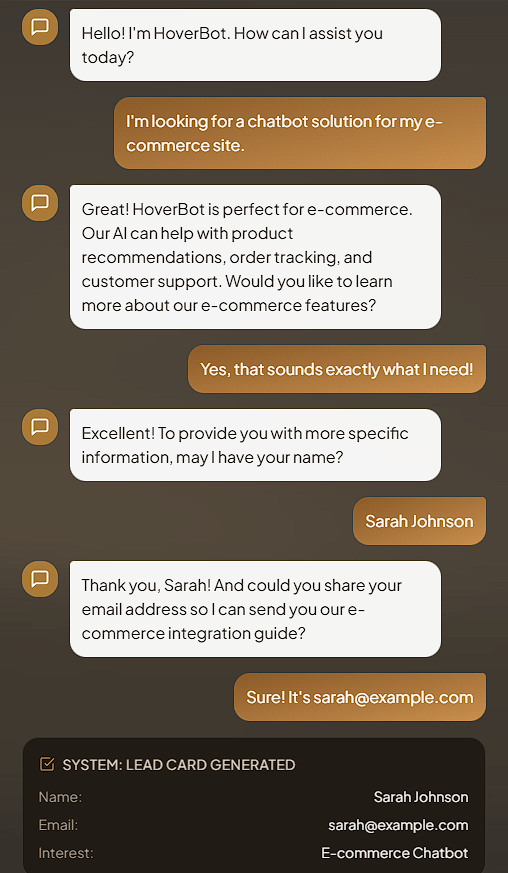
| Lead qualification | Detects intent and captures structured sales information |
| Human escalation | Transfers conversations with context attached |
| PII masking | Removes sensitive data before model processing |
| Analytics | Highlights unresolved questions and knowledge gaps |
HoverBot places unusual emphasis on what happens before customer messages reach the AI model.
The platform says personally identifiable information such as email addresses, phone numbers, and physical addresses can be masked before model inference. It also supports topic allowlists, guardrails, audit logs, and human review for sensitive conversations.
These controls don't automatically make every deployment compliant with every regulation. Companies still need their own legal, security, and data-handling review. But for customer-facing AI, preventing unnecessary personal information from reaching the model is a meaningful design choice.
HoverBot isn't limited to a website widget. Its WhatsApp chatbot uses the same general approach to knowledge-grounded answers, lead capture, escalation, and privacy controls. It also supports multilingual conversations.
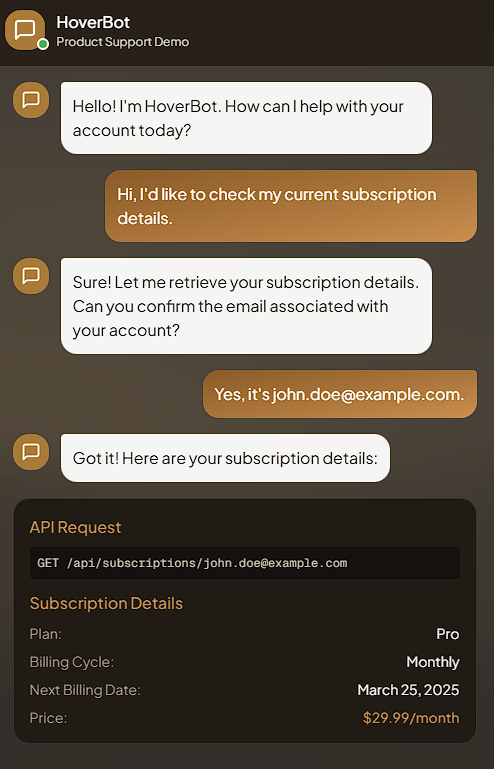
Developers can connect other systems through REST APIs and webhooks. HoverBot documents endpoints for conversations, messages, knowledge sources, and escalations, along with webhook events for qualified leads and human handoffs. OAuth 2.0 is available for multi-tenant integrations.
That makes CRM and helpdesk integration particularly useful. A qualified lead can be pushed into a sales system, while an escalated support conversation can create a ticket for a human team.
Consider an online electronics store.
A visitor asks, "Which laptop should I get for video editing?"
HoverBot first uses the store's product information to identify suitable options. It can ask follow-up questions about workload or preferences, suggest relevant models, and recommend accessories such as additional storage.
If the conversation starts showing strong buying intent, HoverBot can collect the shopper's details and preferences as structured lead information. A webhook can then send that lead to the company's CRM.
If the visitor asks for a custom business quote or wants to speak with someone, HoverBot can escalate the conversation. The salesperson receives the previous discussion, including what the customer was considering, instead of starting cold.
That full sequence is more useful than a chatbot that only answers FAQs.
HoverBot also monitors unresolved conversations. Its dashboard can surface unanswered questions and weak areas in the knowledge base, giving teams a concrete list of content that needs updating.
This is an important part of the product because RAG quality depends heavily on source quality. If shipping rules change or new products are added, the chatbot's information needs to change with them.
HoverBot makes the most sense for ecommerce stores, marketplaces, and customer-facing businesses that receive a steady stream of repetitive product and support questions.
It is particularly useful when conversations often move between support and sales. A shopper may begin by asking about compatibility, then become a qualified lead a few minutes later.
Businesses using WhatsApp heavily for customer communication are another good fit.
HoverBot is specialized. Teams looking for internal automation, research agents, coding assistants, or broad multi-app workflow orchestration should look elsewhere.
The company also currently describes itself as inviting design partners, which suggests the product is still in an earlier stage than long-established support platforms. Teams considering deployment should verify the integrations and operational features they need before committing.
RAG is another safeguard, not a guarantee. Incorrect, incomplete, or outdated source material can still lead to poor answers.
HoverBot is strongest when customer support and product discovery overlap. Its combination of grounded answers, product recommendations, lead qualification, contextual human handoff, PII masking, and knowledge-gap analytics gives it a focused role in ecommerce rather than trying to become a chatbot for everything.
The main caveat is maturity. HoverBot looks most suitable for teams willing to work with a more focused, developing platform in exchange for stronger attention to product context, privacy, and escalation.
TAGS: AI Chat/Assistant
Related Tools:

Facilitates project management and team collaboration

Multilingual chatbot for websites

Design, deploy, and manage AI chatbots

Analyze complex information, write and debug code

Generates text, code, and reasoning solutions

Uses AI to automate responses and assist agents