
Share this tool:
 |
Description:
Equal Time is an AI meeting assistant with a sharper point of view than most notetakers. It does the expected work, transcription, summaries, action items, and searchable meeting history, but its real identity is meeting intelligence for inclusion, communication, and leadership behavior.
| Feature | What it does | Why it matters |
|---|---|---|
| AI Meeting Notes | Generates summaries, action items, decisions, and next steps after meetings | Helps teams avoid losing important meeting outcomes |
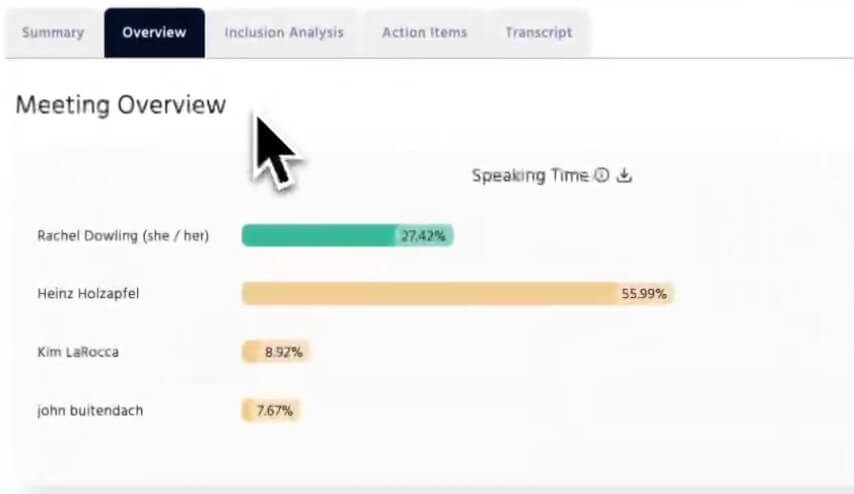
| Participation Analytics | Measures talk time, interruptions, monologues, and speaking balance across participants | Shows who is heard and who may be left out |
| Ask Equal Time | Lets users ask questions about the transcript or request drafts such as follow-up emails | Makes meeting history easier to reuse |
| Custom Vocabulary | Lets users add up to 1,000 custom words or phrases, including names, acronyms, and company jargon | Improves transcript accuracy for company-specific language |
| Workflow Integrations | Sends notes to CRMs, chat tools, intranets, issue trackers, and other tools through webhooks, Zapier, Make, or custom workflows | Moves meeting outputs into the tools teams already use |
| Security Controls | Encrypts meeting data at rest and in transit, gives users ownership of their data, and says data is not used to train its models or third-party LLMs | Supports more careful use of meeting data |
Equal Time works with Zoom, Google Meet, and Microsoft Teams, then turns meetings into transcripts, notes, decisions, next steps, and searchable records. The platform also supports meeting templates for different contexts, such as sales discovery, interviews, team meetings, and classes. Its homepage says it supports 102 languages with auto-language detection, and full transcripts are available inside the Equal Time web app.
That already puts it in the same broad category as tools like Otter, Fireflies, Fathom, and Read AI. But Equal Time is not just trying to be a meeting recorder. It is trying to show what happened socially inside the meeting: who spoke, who was interrupted, who dominated, who was quiet, and how the meeting could have been more balanced.
That makes the product more specific than a general AI notetaker. If all you need is a quick meeting summary, Equal Time can do that. If you want visibility into meeting dynamics, it becomes much more interesting.
Equal Time is strongest in meetings where participation matters. That includes leadership calls, team discussions, DEI-focused meetings, coaching sessions, classrooms, sales calls, interviews, and hybrid meetings where some people may be easier to overlook.
The platform tracks talk time by person and by gender group, detects interruptions and monologues, and includes “mansplaining” detection as part of its inclusivity metrics. Team and company users can also track trends across conversation metrics, such as talk time by seniority level or demographic group.
This is the part that separates Equal Time from standard transcription tools. Most notetakers help you remember what was said. Equal Time tries to help you understand how the conversation worked.
The workflow is familiar if you have used any AI notetaker. Equal Time joins the meeting, records and transcribes the conversation, then creates notes and analysis afterward. It can also connect to a calendar and automatically join meetings based on user settings.
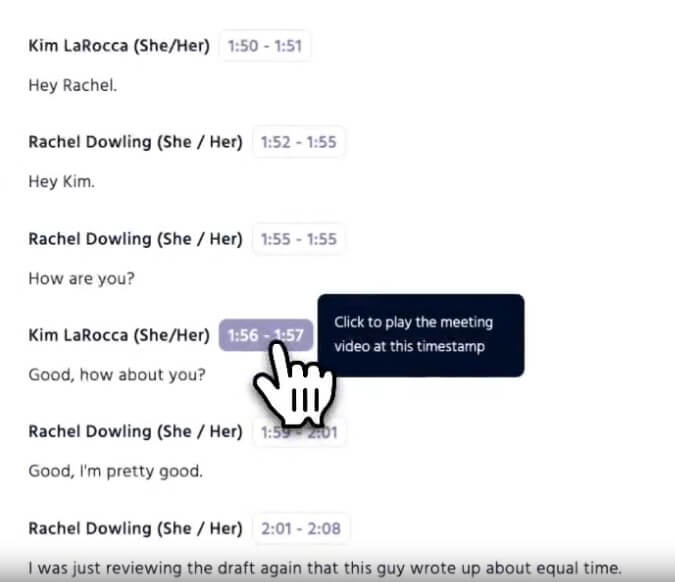
Where the workflow becomes more useful is after the meeting. Instead of leaving users with a static transcript, Equal Time lets them search across meeting history, review timestamped video playback, ask questions about past meetings, and draft follow-ups from the meeting record.
For teams, integrations matter. Equal Time lists Salesforce, HubSpot, Pipedrive, Slack, Microsoft Teams, Notion, Coda, Linear, and thousands of Zapier-supported tools as possible destinations for meeting notes. That makes it useful for sales, customer success, project management, and internal operations where meeting notes often need to move somewhere else.
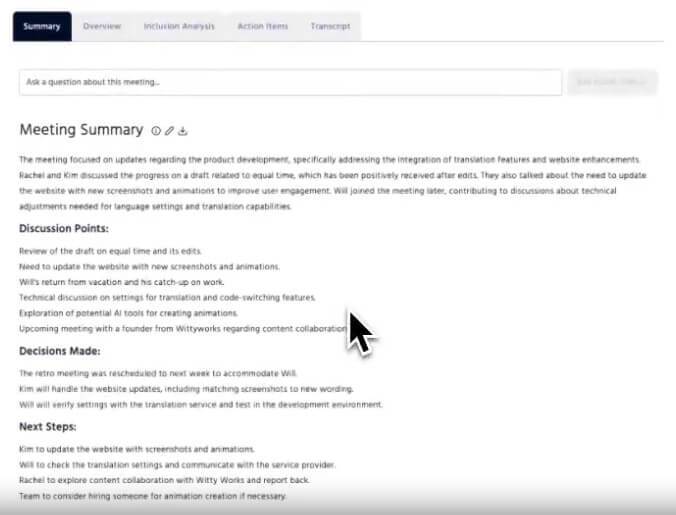
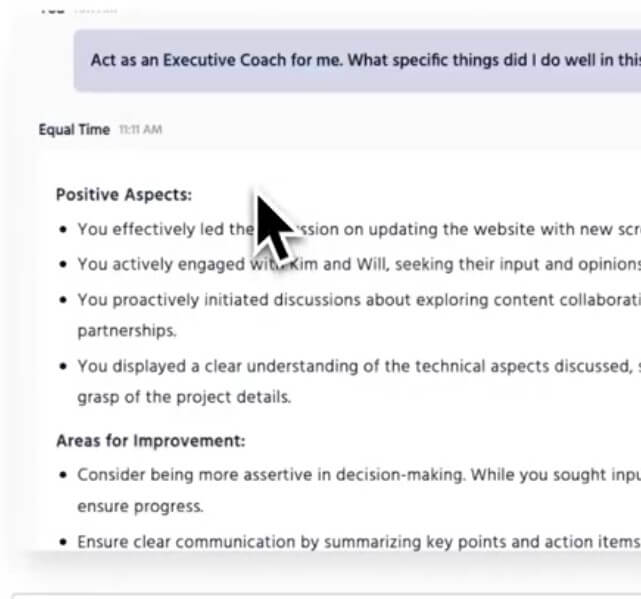
Equal Time’s most distinctive layer is its coaching system. The company positions the product as an AI coach and ally, especially for women in male-dominated workplaces. Its About page says the tool is built to help women gain recognition, improve leadership visibility, and understand what is happening in meetings.
The coaching features include feedback on executive presence, facilitation, hedging language, and communication behavior. Equal Time also describes tools like Credit Keeper, which tracks when ideas are repeated or credited, and Promotion Path nudges, which identify non-promotable tasks and suggest more strategic opportunities instead.
This is useful, but it also makes Equal Time a more opinionated product. Some teams will love that it names meeting patterns directly. Others may need careful rollout, because analytics around gender, interruptions, and communication style can feel sensitive if employees do not understand how the data is being used.
Equal Time supports 102 languages with automatic detection, and its language update says it can also support code-switching within live conversations. Users can also translate an entire transcript into a primary team language.
That matters for global teams. Many meeting tools claim multilingual support, but Equal Time connects language support back to participation and inclusion. The value is not just transcription. It is making sure people who do not speak in the dominant workplace language are still represented in the notes and analysis.
Hybrid meeting support is also important. Equal Time can be used in hybrid mode, where the system labels speakers from an in-room microphone as Speaker A, Speaker B, and so on. That is practical, though not perfect. In-person rooms are harder to transcribe cleanly than individual remote microphones, so teams should test it with their actual setup before relying on it for important records.
Equal Time is best for managers who want better meeting discipline, HR and DEI teams measuring inclusion, sales teams that need summaries and CRM follow-up, educators running online or hybrid classes, and professionals who want coaching on how they show up in meetings.
It is also useful for organizations that want meeting archives to become searchable knowledge. The global search and Ask Equal Time features make past meetings easier to reuse, instead of letting notes disappear into email threads or chat channels.
The biggest trade-off is that Equal Time is more sensitive than a plain notetaker. Measuring gender balance, interruptions, dominance, and mansplaining can create useful awareness, but it also requires trust. Teams should be clear about consent, access, data use, and whether analytics are for personal growth, team improvement, or management reporting.
Another limitation is that coaching insights depend on transcript quality and context. A tool can detect hedging words or interruptions, but it may not fully understand workplace politics, cultural norms, role expectations, or why someone chose not to speak.
It is also not the lightest choice for users who only want simple meeting notes. If your needs are basic, Equal Time may feel more involved than necessary.
Equal Time is best for teams that want meeting notes plus insight into participation, communication, and inclusion. Its strongest value is not transcription alone. It is the combination of summaries, searchable transcripts, talk-time analytics, coaching feedback, custom vocabulary, multilingual support, and workflow integrations. The main caveat is that its most useful features also require thoughtful rollout. Used well, Equal Time can help teams run fairer and more productive meetings. Used casually, the analytics may feel too personal or too sensitive. Its best fit is a team that wants better meeting records and is ready to have more honest conversations about who gets heard.
TAGS: Productivity
Related Tools:

Enhances ChatGPT user interaction and functionalities

AI-powered writing tool for paraphrasing
Helps users analyze and explore massive datasets

Summarizes and take notes from videos

Simplifies the use of diverse applications

Uses AI to analyze, automate, and visualize data