

Share this tool:
 |
Description:
Danelfin is an AI-powered stock analytics platform for investors who want to research stocks and ETFs without manually sorting through a long list of technical, fundamental, and sentiment indicators.
Its central feature is the AI Score, a rating from 1 to 10 that represents the platform’s estimate of an asset’s probability of outperforming the market over its core investment horizon. Instead of presenting hundreds of separate metrics, Danelfin processes them through its models and turns the result into a rating that is easier to read.
The important distinction is that Danelfin is a research and stock-picking tool, not an automated portfolio manager. It provides rankings, signals, forecasts, historical context, and portfolio monitoring that investors can use alongside their own judgment.
Danelfin analyzes more than 10,000 features for each stock or ETF, drawing on hundreds of technical, fundamental, and sentiment indicators. These include momentum, volatility, RSI, EBITDA, earnings growth, valuation ratios, analyst expectations, short interest, and insider activity.
The system combines that information into its 1-to-10 AI Score. A higher score indicates a higher modeled probability of outperforming the relevant market. A lower score indicates a lower modeled probability.
That compression is Danelfin’s main usability advantage. Investors can identify stocks worth researching without interpreting every indicator first.
The score is not a promise that a stock will rise. Markets are affected by events and forces that historical models cannot reliably anticipate, a limitation Danelfin acknowledges itself.
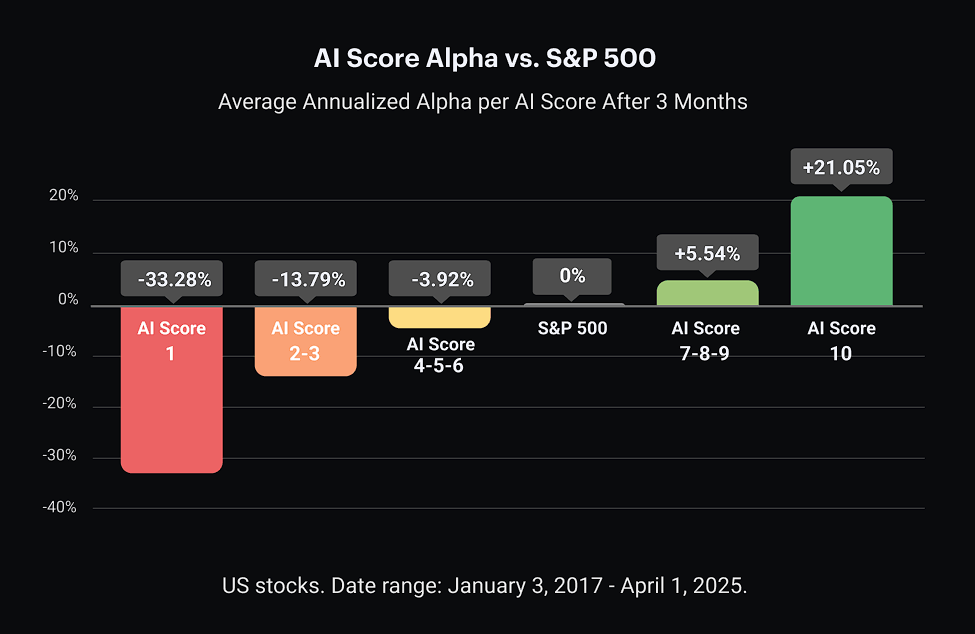
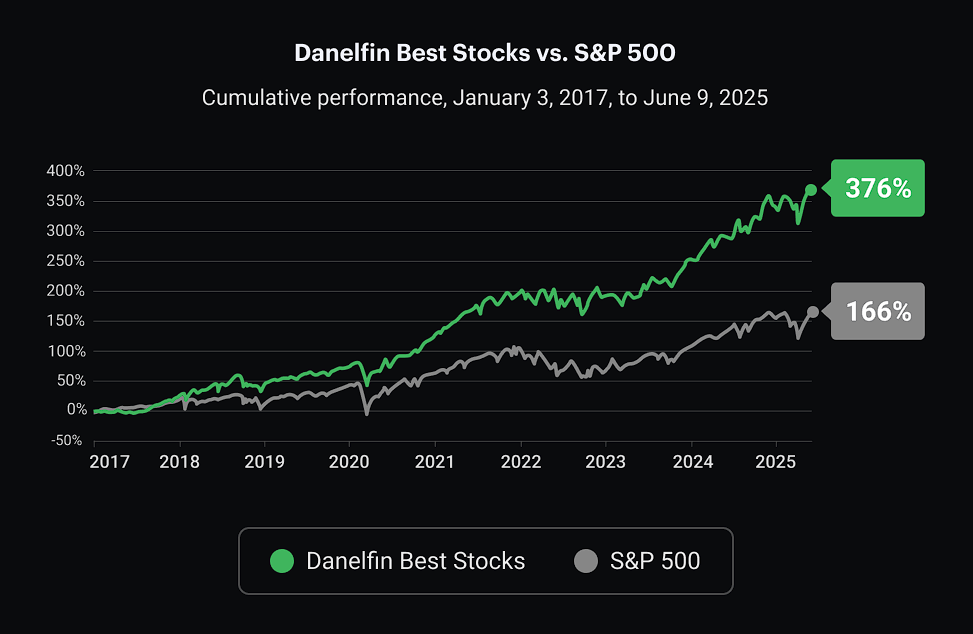
Danelfin does not stop at the combined AI Score. It separates the analysis into Fundamental, Technical, and Sentiment subscores, giving investors a clearer idea of what is driving a stock’s rating.
| Analysis | What It Helps Evaluate |
|---|---|
| AI Score | Overall probability of market outperformance |
| Fundamental | Business performance, valuation, profitability, and related metrics |
| Technical | Price action, momentum, volatility, and market indicators |
| Sentiment | Analyst expectations, transactions, short interest, and related signals |
| Low Risk | Additional context around investment risk |
| Score Evolution | How the AI’s assessment changes over time |
The subscores are especially useful when two companies have similar overall ratings. An investor focused on company fundamentals can inspect the Fundamental score instead of treating the headline rating as the entire analysis.
A stock-ranking platform is difficult to trust when it produces a number without showing what influenced it.
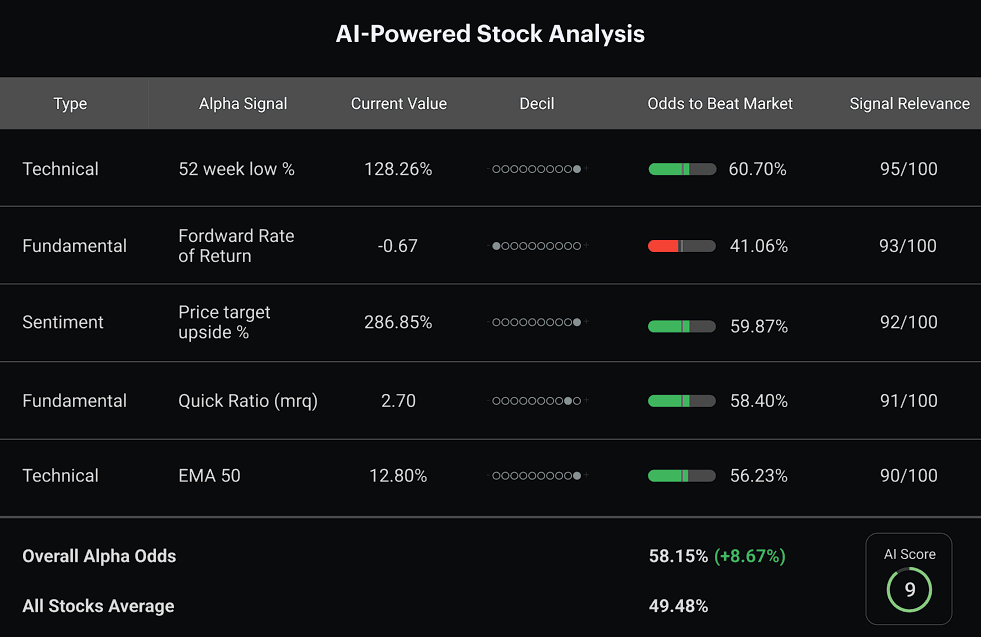
Danelfin addresses that problem with Explainable AI. Users can inspect the stock features, which Danelfin calls alpha signals, that contribute to an AI Score instead of relying on a completely opaque recommendation.
That does not make the model infallible, but it makes the research process easier to follow. Investors can see whether a rating lines up with the factors they care about and investigate unusual signals rather than accepting the score automatically.
In practice, Danelfin works better as a research filter than as a replacement for investment judgment.
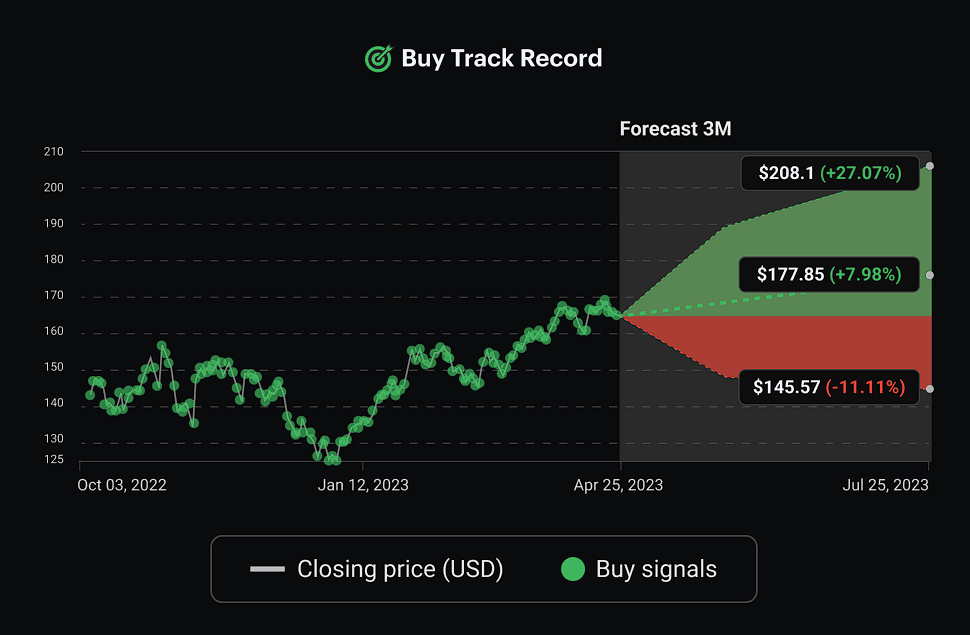
The Trade Ideas section narrows Danelfin’s large investment universe into potential opportunities where its historical signals have shown a stronger record.
Users can explore long and short ideas and filter opportunities by investment horizon. Each idea can include historical signal performance, forecasts, chart patterns, and other information that helps explain the setup.
This is more useful than a generic list of “top stocks” because Danelfin connects current signals with their past behavior. Historical win rates still do not guarantee that future signals will behave the same way.
Danelfin also works as a discovery tool. Investors can browse stocks, ETFs, sectors, industries, and investment themes instead of starting only with tickers they already know.
That makes it useful early in the research process. You can use the rankings to build a shortlist, inspect the underlying scores and signals, compare candidates, and then move into deeper company research before making a decision.
That is a more sensible workflow than treating the highest AI Score as an automatic buy signal.
Danelfin’s portfolio tools apply the scoring system to investments users already follow.
Investors can monitor changes in AI Scores and receive alerts when stocks are upgraded or downgraded. Portfolio-level tools include an Average AI Score and Portfolio Diversity Score, which provide another way to review a group of holdings.
This gives Danelfin a role after the initial stock search. Users can watch how the platform’s assessment changes without checking each rating manually.
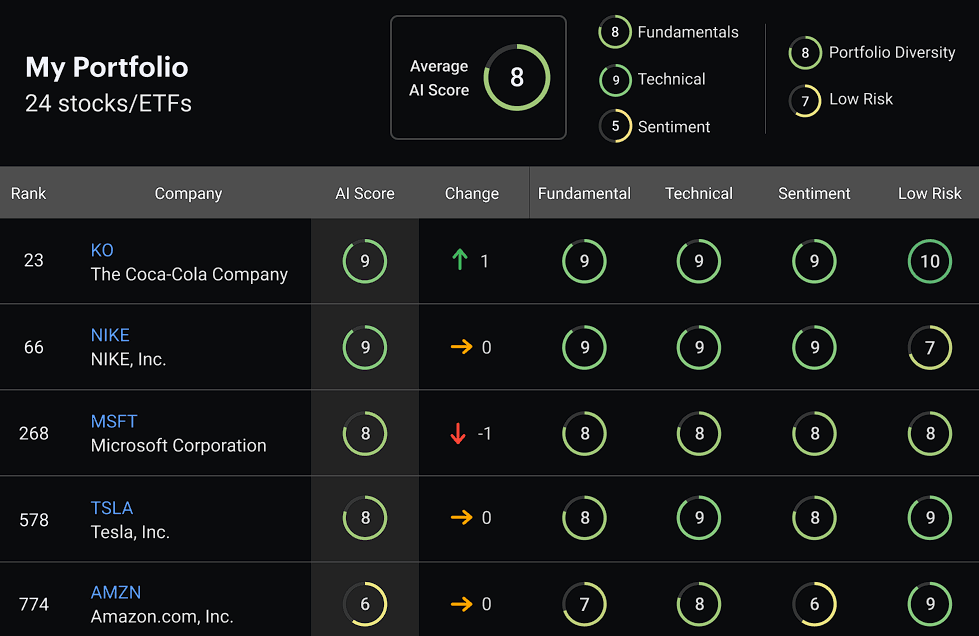
Danelfin suits self-directed investors who want quantitative analysis without building their own models. It can help with screening large groups of stocks, comparing candidates, finding trade ideas, monitoring existing holdings, and adding an AI-based signal to a broader research process.
More advanced users may also value the API, which allows supported data and analytical tools to feed into external screeners and investing workflows.
The easiest limitation to overlook is also the most important: a high AI Score is not certainty.
Unexpected company news, macroeconomic shifts, geopolitical events, and changes in investor behavior can overwhelm patterns learned from historical data.
The amount of information can also tempt investors to put too much weight on quantitative signals. Fundamental, technical, and sentiment analysis can improve research, but none of them removes market risk.
Danelfin works best as another analytical layer, especially for screening and comparison, rather than as the sole reason to buy or sell an investment.
Danelfin is good at turning a large amount of market data into signals that are quick to interpret but still open to inspection.
The AI Score makes stock screening accessible. The subscores, explainable signals, Trade Ideas, rankings, and portfolio-monitoring tools provide enough detail to investigate what sits behind the headline rating.
It suits self-directed investors who want AI to narrow the research field and surface useful signals while keeping the final decision in their own hands. The basic limitation remains: Danelfin can estimate probabilities from market data, but it cannot remove the uncertainty that comes with investing.
TAGS: Finance
Related Tools:

Assists in connecting with investors

Provides dynamic scheduling, resource management, and real-time tracking

Automates bookkeeping and financial processes,

Enhances team productivity and task organization

Helps users understand cryptocurrency and trading strategies

Digital whiteboard that enables teams to collaborate