

Share this tool:
 |
Description:
Bookeeping.ai is an AI-first accounting platform built around Paula, an AI accountant that handles much of the repetitive work involved in small-business bookkeeping. It covers transaction categorization, receipt matching, reconciliation, financial statements, invoicing, document analysis, and ongoing financial monitoring.
The difference between Bookeeping.ai and a basic finance chatbot is that Paula can work with the books themselves. The goal is not just to answer accounting questions, but to turn those questions into useful actions while keeping the ledger, reports, and supporting documents connected.
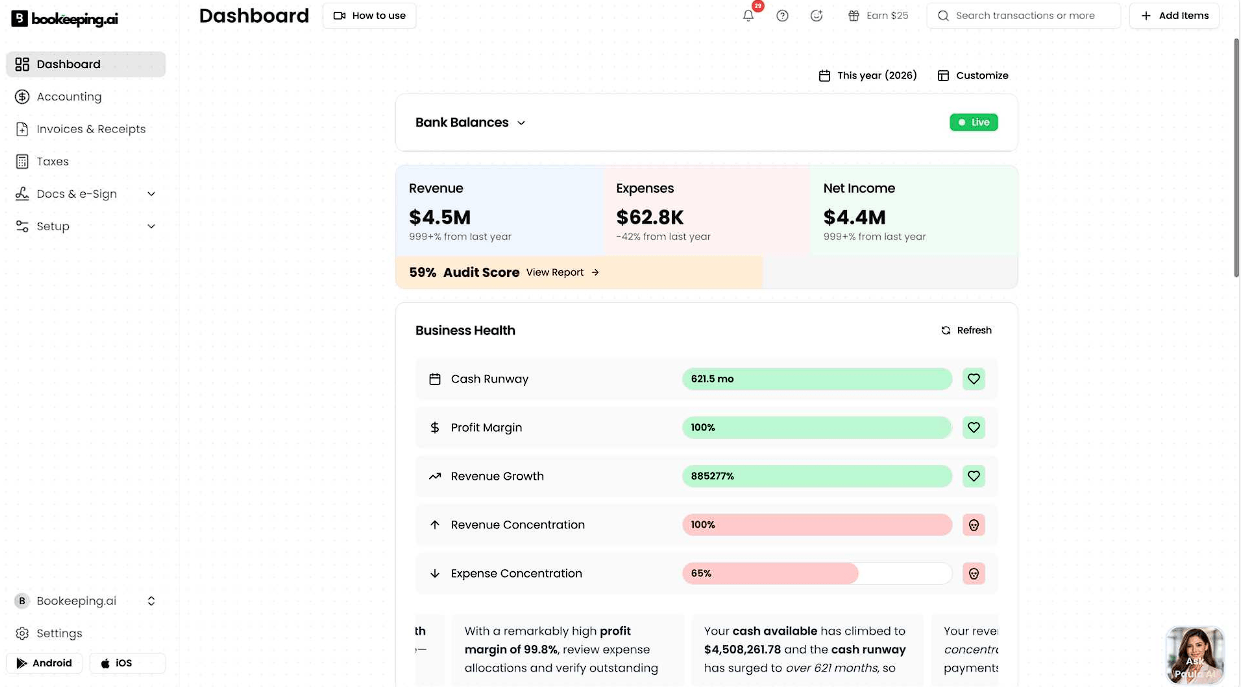
The bookkeeping engine is still doing most of the heavy lifting behind the conversational interface.
Businesses can connect bank and card accounts, import transaction files, or sync services such as Stripe, Shopify, and Airbnb. Bookeeping.ai can then categorize transactions, split entries, identify refunds and transfers, detect duplicates, and match receipts to transactions. Custom categories and charts of accounts are supported as well.
That matters because AI bookkeeping only earns its keep when it removes real administrative work. Matching a receipt to the correct transaction is more useful than producing another summary of spending.
Bookeeping.ai also uses double-entry ledger automation. According to the company, ledger calculations rely on deterministic accounting logic rather than asking a generative model to invent the numbers. AI helps analyze information, flag issues, and support decisions, while users can review and approve activity through an audit trail.
Paula is the main way users interact with the platform. You can ask about financial activity, request an explanation of a trend, analyze a document, or tell the system to complete a supported accounting task.
For example, Paula can create an invoice from a conversational request, explain an unfamiliar transaction, summarize income and expenses, or help find missing documentation. Bookeeping.ai also provides access to ChatGPT, Gemini, and Claude within its AI environment.
The useful distinction is that conversation and execution happen in the same workflow. A typical finance chatbot might explain how invoicing works. Paula can create the invoice inside the accounting system.
That saves some context switching, especially for business owners who would rather not spend the day digging through accounting menus.
Bookeeping.ai includes task-specific AI agents that watch different parts of the business.
The Monthly Close Agent can reconcile accounts, chase missing receipts, and prepare a close report. The Invoice Chaser Agent monitors overdue invoices, while the Business Health Agent reviews areas such as margins and runway. Other agents focus on tax information, market monitoring, and prospect discovery.
The idea is simple: instead of waiting for someone to notice a problem, the software monitors activity and flags issues that may need attention.
Those recommendations still require judgment. An unusual transaction might signal a real problem, be completely harmless, or simply reflect incomplete records.
Bookeeping.ai generates core financial reports such as profit and loss, balance sheet, cash flow, and trial balance. It can also report on counterparties, liabilities, expenses, income, classes, and transaction anomalies.
| Area | What Bookeeping.ai Handles |
|---|---|
| Bookkeeping | Categorization, ledger entries, splitting, transfers, refunds |
| Receipts | Extraction and transaction matching |
| Reporting | P&L, balance sheet, cash flow, trial balance |
| AI Assistant | Questions, analysis, documents, and accounting actions |
| Agents | Close, invoice follow-up, business monitoring, tax monitoring |
| Invoicing | Creation, recurring invoices, reminders, payment matching |
| Connections | Banks, Stripe, Shopify, Airbnb, file imports, API |
The range is useful because bookkeeping, invoicing, and reporting are connected rather than treated as separate tasks. Activity in one part of the system can contribute to the rest of the financial picture.
Bookeeping.ai is a good fit for freelancers, founders, small businesses, and accounting professionals who spend too much time cleaning transactions, chasing receipts, reconciling accounts, or preparing routine reports.
It looks especially useful for businesses with frequent payment-platform activity. Stripe, Shopify, and Airbnb transactions can include payouts, processing fees, refunds, taxes, and adjustments, all of which become tedious to reconcile by hand.
Accountants can use Bookeeping.ai as an automation layer without giving up control of the books. The platform includes exception review, anomaly detection, reconciliation tools, client reporting, audit logs, and workflows designed for accounting professionals.
The most important limitation is Bookeeping.ai’s focus on cash-based accounting. Businesses with more complex requirements should confirm that this approach fits before replacing an existing system. Bookeeping.ai itself advises users to check their eligibility with a local accountant.
Automation does not remove the need for review. Receipt extraction, categorization, anomaly detection, and AI recommendations can reduce the workload, but unusual transactions and tax-sensitive decisions still need human attention.
The broad feature set may also be more than someone needs if all they want is basic expense tracking.
Bookeeping.ai is best understood as an automated accounting workspace with an AI operating layer, not simply an accounting chatbot.
Paula makes financial information easier to question and act on, but the deeper value is in the bookkeeping engine underneath: transaction processing, receipt matching, reconciliation, reporting, invoicing, audit checks, and recurring financial agents.
It is best suited to small businesses and accounting professionals that want to reduce repetitive finance work without losing visibility into the books. The important qualification is that AI can handle much of the routine work, while complex accounting and tax decisions still require informed human review.
TAGS: Finance
Related Tools:

Comprehensive digital note-taking tool

Enables teams to plan, track, and manage their work

Automates bookkeeping and financial processes,
Automates financial record-keeping and expense management

Streamlines project management and collaboration

Assists in connecting with investors